




Your shopping cart is currently empty.
Dexter 9K to 16K Axles: What to Match Before Ordering
Replacing a Dexter 9K to 16K axle takes more than finding a heavier tube. The axle model, wheel ends, brakes and suspension must work together. Two axles with the same capacity can use different bearings, brake widths, wheels and attaching parts.
This guide covers Dexter leaf-spring axles beyond the lighter stock and custom beams. It is for owners matching a replacement and builders specifying heavier running gear. If your trailer has rubber torsion suspension instead of leaf springs, use How Dexter Torflex Axles Work, and How to Pick a Replacement and the Dexter Torflex axle selection.
Key takeaway
- Capacity alone does not identify the axle. Dexter separates 10K General Duty from 10K Heavy Duty. Match the model and wheel-end configuration.
- Keep hub face, track and spring center separate. These are different measurements, especially with dual wheels.
- The suspension changes too. Dexter documents different slipper-spring widths and hanger systems across this range.
- 16K is a distinct system. Dexter's D160 has its own wheel-end parts; it is not a renamed 15K axle.
What does Dexter's 9K to 16K range include?
Dexter calls this its medium-duty sprung-axle range. The Medium Duty Catalog documents 9,000 and 10,000 lb. General Duty axles and 10,000, 12,000 and 15,000 lb. heavier configurations. Dexter's later Dex-Treme D160 information adds the 16,000 lb. system. These are ratings for one axle, not the trailer's total carrying capacity.
| Capacity | Dexter family | Important distinction |
|---|---|---|
| 9,000 lb. | D90 | General Duty wheel ends and suspension |
| 10,000 lb. General Duty | D100G / D100GD | Not the same wheel-end package as 10K Heavy Duty |
| 10,000 lb. Heavy Duty | D100HD | Separate hub, bearing and brake specifications |
| 12,000 lb. | D120 | Low-profile and high-profile hub configurations are documented |
| 15,000 lb. | D150 | Hub-piloted dual-wheel configuration with a metric bolt circle |
| 16,000 lb. | Dex-Treme D160 | Distinct hub group and suspension requirements |
For trailer loading, hitch weight and GAWR, start with Choosing Trailer Axle Capacity: Hitch Weight, GAWR, Wheels and Tires. Dexter limits an assembly to its lowest rated component. A stronger beam alone does not establish a higher trailer rating.
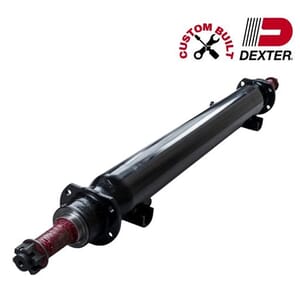
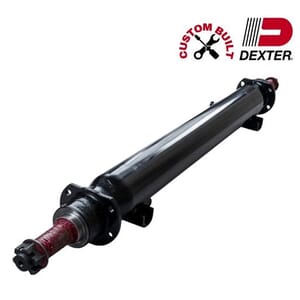
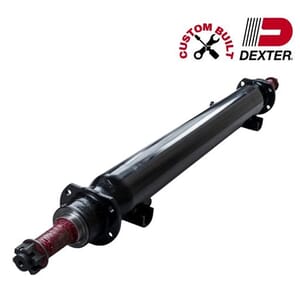
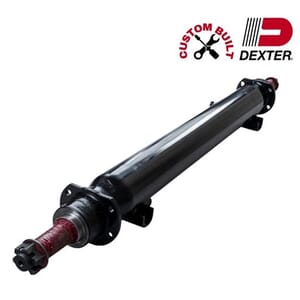
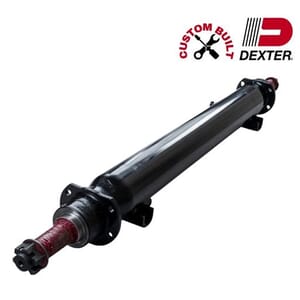
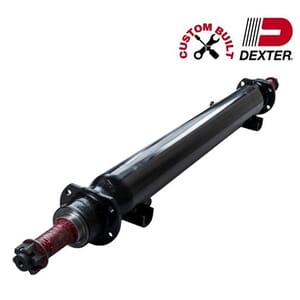
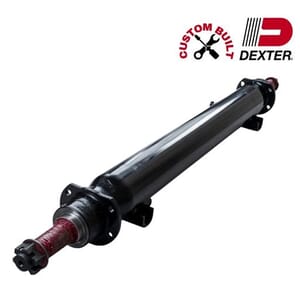
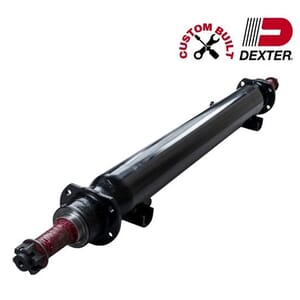
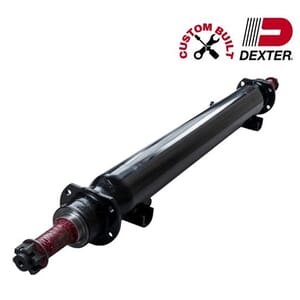
You can order these as custom built beams from Custom Built Dexter Trailer Axles. That selection includes a 9,000 lb. standard spring beam, a 10,000 lb. General Duty slipper spring beam, a 10,000 lb. Heavy Duty spring beam, a 10,000 lb. Heavy Duty air-brake beam with spiders, a 12,000 lb. Heavy Duty spring beam, a 12,000 lb. air-brake beam with spiders, a 15,000 lb. spring beam, a 15,000 lb. air-brake beam with spiders, and a 16,000 lb. Dex-Treme D160 spring beam. Those forms ask for hub face from 45" to 95" and the spring center. The overhang has to fall in the range the form shows for that setup. The D160 form lists an overhang limit of 29.00" to 33.00". The 12,000 lb. forms include a hi-profile choice for 16" and 17.5" dual wheels. On the air-brake beams, the spiders are on the beam.
How these axles differ from the lighter beams
Dexter's light-duty catalog ends at 8,000 lb. Its medium-duty utility beam description calls out high-strength tubing, forged carbon-steel spindles and machined, piloted brake flanges. Dexter says the material permits a stiffer beam with no camber required. Do not apply a light-duty custom beam's camber choices or dimensional limits to this range.
Tube dimensions also depend on the model. For example, Dexter specifies a 5" round tube with a .44" wall for the D160. That is a D160 specification, not a rule for every 9K to 16K axle. Match U-bolts, tie plates and spring seats to the actual tube and suspension.
The heavier wheel ends bring other differences: wider brakes, different bearings and seals, and hub-piloted single or dual wheels. Oil lubrication is prominent in Dexter's medium-duty wheel-end tables, but grease is also documented in the service manual and the D160 specifications. Do not assume an E-Z Lube or Nev-R-Lube choice from a lighter axle carries over.
Step 1: Identify the existing axle
Photograph the entire axle label before measuring. Record the model, rated capacity, serial or lot number, Dexter part number if shown, hub face (HF) and spring center (SC). Dexter's label guidance uses SC for leaf-spring axles; outside of bracket (OB) belongs to Torflex identification.
If the label is missing, gather the axle's identifying marks and photographs of the hubs, brakes and suspension. Use How to Identify Your Old Trailer Axle and Order a Dexter Replacement. Supply the complete identification number rather than trying to turn it into a description-number decoder.
Step 2: Match width, spring centers and ride height
- Hub face: The distance between the wheel-mounting surfaces of the two hubs.
- Spring center: The distance from the center of one leaf spring to the center of the other.
- Track width: The distance between tire centerlines. With dual wheels, Dexter uses the center of each wheel-and-tire pair.
Do not enter a listing's track measurement as hub face without confirming which dimension is being requested. Wheel offset and hub configuration affect the relationship. Dexter also publishes model-specific overhang limits. Some charts describe overhang per side, while other system specifications use a total difference. Have the dimensions checked against the exact axle and suspension, not a different beam's chart. The 16,000 lb. Dex-Treme D160 custom beam form lists an overhang limit of 29.00" to 33.00", which is tighter than its 45" to 95" hub-face window.
Record straight or drop spindle configuration, spring-seat position, spring width and axle spacing. Overslung means the springs are above the tube; underslung means they are below it. Seat position is not the same thing as a drop spindle. Dexter specifies a straight spindle for D160; do not assume the 4" drop options on lighter beams are available here.
The forms covered in Custom Built Dexter Axle Order Checklist: Before You Submit are for the lighter standard spring beams. Use their measurement discipline, not their form limits or option menu, to plan a heavier axle order.
Step 3: Match brakes and wheel ends
For electric drum brakes, Dexter lists 12-1/4" x 3-3/8" for 9K and 10K General Duty, 12-1/4" x 4" for 10K Heavy Duty, and 12-1/4" x 5" for 12K and 15K. The 12K and 15K assemblies have separate part numbers even though their nominal size matches.
Record electric drum, hydraulic drum, hydraulic disc or air brakes as equipped. Brake availability depends on the model; not every type fits every capacity. Match the flange, backing plate or caliper, hub/drum or rotor and any ABS equipment. Dexter also separates General Duty hub designs by production period. An old and new hub group should not be treated as interchangeable just because both say 10K.
For electric axles with inner wiring, Dexter says the wires exit the tube toward the rear. Record the existing routing and confirm what the replacement includes. Pre-wiring does not provide the rest of the trailer's brake-control or breakaway system.
Step 4: Check wheels, tires and lubrication
17.5" wheels are common in the heavier assemblies, but diameter alone is not a fitment specification. Southwest Wheel's 10K General Duty and 12K packages include examples with eight 215/75R17.5 dual wheel-and-tire assemblies for two axles. Dexter's catalog also documents other wheel-and-tire combinations.
Check bolt circle, pilot bore, stud and nut type, offset, load rating and pressure rating. Dexter's catalog describes 9K-12K hubs with an 8 on 6.50" bolt circle and 4.75" pilot bore, while the 15K uses 8 on 275 mm and a 221 mm bore for dual wheels. D160 also uses 8 on 275 mm with a 221 mm pilot, but Dexter specifically says D160 and D150 hubs and hub components are not interchangeable.
Identify oil or grease lubrication before ordering bearings, caps and seals. Use the lubricant and service procedure for the actual wheel end. An oil cap is not a reason to use a lighter axle's bearing-adjustment procedure.
A current oil-seal change to know
Dexter introduced spindle-mounted oil seals as standard production beginning in June 2026 for D100HD, D120, D150 and D160 axles. Its bulletin says service customers can use the new spindle-mounted seal or the existing drum-mounted seal because the drum-and-spindle design is unchanged. Confirm the seal and its installation instructions for your axle; do not automatically repeat an older catalog's seal selection.
Step 5: Match the suspension, not just the springs
Dexter's medium-duty catalog shows slipper-spring systems with 2" springs for 9K, 2-1/2" springs for 10K General Duty, and 3" springs for the heavier 10K-15K family. It also documents heavy-duty double-slipper suspension. These are different combinations, not a universal hanger kit.
Match spring capacity, width, length, eye and bushing, hangers, equalizers, U-bolts, tie plates and axle spacing as a system. A slipper spring slides at its rear support rather than using a double-eye spring's rear shackle arrangement. For identification help, see Double-Eye vs Slipper Leaf Springs.
For a leaf-spring D160, confirm the HDSS configuration and its installation requirements. Dexter also offers D160 with air suspension, which is a separate configuration, not a substitute hanger kit for this leaf-spring guide.
What to have ready before ordering
| Record | Confirm before ordering |
|---|---|
| Label and identification | Model, capacity, complete serial/lot number and part number |
| Dimensions | HF, SC, track if supplied, and applicable overhang limits |
| Beam and seats | Tube size, spindle style, spring-seat position and width |
| Brakes and hubs | Type, size, production generation, flange and ABS if present |
| Wheels and lubrication | Single/dual fitment, pilot, bolt circle, hardware, oil/grease and seal design |
| Suspension and order contents | Spring and hanger system, axle count/spacing, and exactly which parts are included |
Use a qualified installer to inspect the existing running gear and install the replacement. Dexter assigns proper axle alignment to the installer. Its tire-wear guidance directs toe and camber problems to an alignment shop. Southwest Wheel sells new product; it does not provide axle installation or alignment service.
FAQ
Are Dexter 10K General Duty and Heavy Duty axles the same?
No. Dexter documents separate hub groups, bearings, brake widths and suspension parts. Match the model, not only the 10,000 lb. rating.
Does every 9K to 16K axle require 17.5" wheels?
No. Confirm the specific hub, wheel and tire combination. Matching diameter or bolt count alone does not confirm the pilot, offset, hardware or load rating.
Can I replace a 15K axle with a D160 and reuse its hubs?
Do not plan on it. Dexter says D160 and D150 hubs and hub components are not interchangeable. A capacity change needs a complete compatibility review.
Can I order a 16K axle through the lighter custom-beam form?
No. Do not use a 2,000 lb. to 8,000 lb. custom beam form for a heavier axle family. Use the matching 9K to 16K form on Custom Built Dexter Trailer Axles. For a 16,000 lb. axle, that is the Dex-Treme D160 form, not a 15K form with different numbers.
Ready to match your heavier Dexter axle?
Start with the 9K to 16K beam forms on Custom Built Dexter Trailer Axles. If you need a pre-configured complete axle instead, compare our 10,000 lb. Dexter axles, 12,000 lb. Dexter axles and 15,000 lb. Dexter axles. Verify fitment before ordering or contact Southwest Wheel for assistance.
Shop Custom Built Dexter Trailer Axles
Have your axle label and measurements ready. Call Southwest Wheel at 1-800-866-3336.
Southwest Wheel - Your Trailers Best Friend Since 1919.
References
- Dexter Light Duty Catalog, 600-8,000 lbs. Axle Capacity (LIT-122-00): cover (Capacity Scope).
- Dexter Medium Duty Catalog, 9,000-15,000 lbs. Axle Capacity (LIT-123-00): page 3 (Load Ratings; Axle Orientation); page 5 (Options for Spring Suspension Axles); page 6 (Dexter Medium Duty Utility Axle Beam Features); pages 8-10 (General Duty Hubs); page 12 (10K, 12K and 15K Hubs); page 13 (Electric Brakes); pages 21-26 (Suspensions); page 30 (Wheels and Tires; Axle Overhang).
- Dexter Operation Maintenance Service Manual, 9,000-15,000 Lb. Axles (LIT-006-00): pages 57-62 (Bearing Lubrication; Seal Inspection and Replacement; Installation/Adjustment); page 64 (Axle and Suspension Installation); pages 65-66 (Slipper Leaf Springs; Inspection and Replacement); page 74 (Wheel Selection); page 78 (Tire Wear Diagnostic Chart).
- Dexter Axles Glossary: Hub Face; Track Width; Spring Center; Axle Capacity; Overhang; Drop Height; Overslung; Underslung.
- Dexter Product Bulletin 356R, Axle Label Change: page 1 (Identification Fields).
- Dexter Product Bulletin 466, Dex-Treme D160 Genuine 16,000 lbs. Solution: page 1 (Product Specifications; Suspension Options); page 4 (Hub Group; Non-Interchangeability Note).
- Dexter Product Bulletin 532, 10,000-16,000 lbs. Spindle Mounted Seal: page 1 (Production Change; Service Compatibility).


