





Your shopping cart is currently empty.
How Dexter Torflex Axles Work, and How to Pick a Replacement
A Dexter Torflex axle does not use leaf springs. The suspension is built into the axle itself, so replacing one is not like swapping a spring or a hanger. You match the model, the capacity, the bracket layout and the start angle, then the hubs and brakes.
This guide explains how Torflex works and what to record before you order a new one. It uses Dexter's own catalogs, glossary and product bulletins. Southwest Wheel sells new Dexter Torflex axles and mounting kits. Always follow Dexter's instructions for the specific axle.
Key takeaway
- Torflex is a rubber torsion axle. Dexter describes a steel torsion bar surrounded by four rubber cords inside the axle tube. Each wheel rides on its own torsion arm.
- The label shows OB, not SC. A Torflex label shows the outside of bracket (OB) dimension where a leaf spring axle label shows spring center (SC). Newer labels also show the start angle.
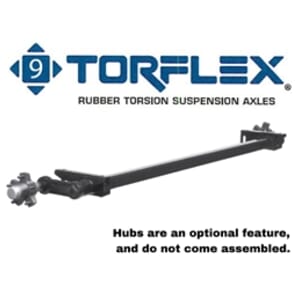
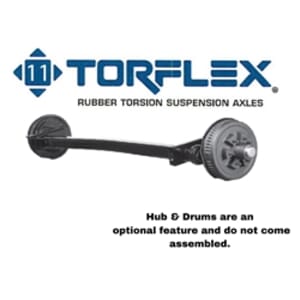
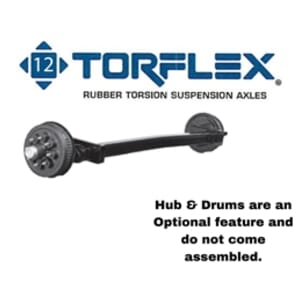
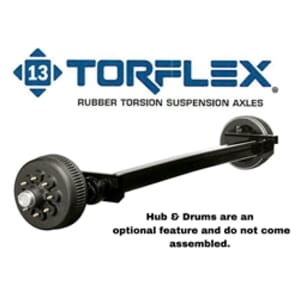
- Match the model number and capacity. Dexter's Torflex models (#9, #10, #11, #12, #13 and others) cover different capacity ranges and use different brackets and mounting kits.
- Start angle and bracket style set ride height. Dexter says the start angle is a factor in determining frame height. Bracket profile and top or side mount change it too.
- Triple axles need a triple model. Dexter does not recommend triple axle assemblies for most Torflex models. The #12T and #13T are the models Dexter designs for triples.
What is a Dexter Torflex axle?
Dexter calls Torflex "a torsion arm type suspension which is completely self-contained within the axle tube." It bolts to the trailer frame with brackets that are part of the axle assembly. Inside the tube, a heat-treated steel inner bar is surrounded by four rubber cords. A forged torsion arm on each end carries the spindle.
When a wheel hits a bump, the arm turns the inner bar and the rubber cords take the load. Dexter credits the natural hysteresis of the rubber for shock absorption and says the rubber cushioning eliminates metal-to-metal contact. Each wheel moves on its own arm, which is why Dexter calls it independent suspension.
How it differs from a leaf spring axle
A leaf spring axle is a straight or drop tube clamped to leaf springs with U-bolts. The springs hang from hangers and shackles on the frame. A Torflex axle has no springs, hangers, shackles or equalizers. The brackets bolt or weld directly to the frame. Leaf spring hanger and shackle parts do not apply to a Torflex axle. For heavier leaf-spring axles rather than rubber torsion, see Dexter 9K to 16K Axles: What to Match Before Ordering.
Dexter also notes a simple way to tell the front of a Torflex axle: the wheel center trails behind the axle tube.
Step 1: Read the label
Start with the Dexter label on the axle tube. Our guide How to Identify Your Old Trailer Axle and Order a Dexter Replacement shows where the label is and what to do if it is missing. Here is what matters on a Torflex label.
Dexter Product Bulletin 356R says the label carries "the serial number of the axle, Dexter part number if available, capacity of the axle, hub face (HF) and spring center (SC), or outside of bracket (OB) if it is a Torflex axle." Bulletin 422 (2020) lists the newer label fields, including the axle model and capacity and "Hub Face, Spring Center, Outside of Bracket and Start Angle." Its sample label reads "#12 CAPACITY: 7,000 LBS HF: 95.00 OB: 77.00 SA: 10UP."
Write down the model number, the capacity, HF, OB and start angle (SA) exactly as printed. Do not try to decode the serial number yourself. Only Dexter knows what the serial means, so give the full number when you call.
Step 2: Know the Torflex model and capacity
Dexter builds Torflex in numbered models, and each model covers a capacity range. The model number decides the bracket, the mounting kit and which hubs and brakes fit. Use the label first. Use this table to check that the model and capacity agree.
| Torflex model | Dexter capacity range | Triple axle use |
|---|---|---|
| #9 | 1,000 - 2,200 lbs. | Not recommended |
| #10 | 2,300 - 4,000 lbs. | Not recommended |
| #11 | 4,100 - 6,000 lbs. | Not recommended |
| #12 / #12T | 5,500 - 7,000 lbs. | Not recommended for #12; #12T is designed for triples |
| #13 / #13T | 8,000 lbs. | Not recommended for #13; #13T is designed for triples |
| #13G | 9,000 - 10,000 lbs. (general duty) | Not recommended |
| #14 | 12,000 lbs. | Not recommended |
Dexter states that the capacity of any assembly is limited to the lowest rated component. Wheels and tires must carry the load too. For more on reading ratings, see Choosing Trailer Axle Capacity.
Step 3: Measure hub face and outside of bracket
Torflex uses two width measurements. Dexter defines them this way:
- Hub face (HF): "The dimension from the wheel mounting surface on one hub to the wheel mounting surface of the other hub on the same axle."
- Outside of bracket (OB): "The dimension from the outside of one mounting bracket to the outside of the other mounting bracket."
Dexter's installation pages say the bracket dimension "is usually matched to the outside measurement of the frame members." Measure the brackets themselves, not just the frame. Dexter also notes that axle capacity may be derated if the overhang (hub face to bracket edge on Torflex) exceeds the recommended dimensions. Match both HF and OB.
Leaf spring measuring steps use spring center. On a Torflex axle, use OB in its place.
Step 4: Match the start angle
Dexter defines start angle as "the angle of the torsion arm relative to the horizontal plane, stated in the unloaded condition. This angle is a factor in determining the frame height." Dexter's catalog lists these start angles: 45 degrees down, 32 degrees down, 22.5 degrees down, 10 degrees down, 0 degrees, 10 degrees up and 22.5 degrees up.
A different start angle puts the trailer at a different height. It also changes the distance from the mounting holes to the wheel center, which matters for fender clearance. Dexter's bracket chart allows 3 inches over the tire at full load. Read the start angle from the label. If the label is gone, call us before you guess.
Step 5: Match the brackets and mounting
The brackets are part of the axle, so they must match your frame:
- Bracket profile: Dexter offers high and low profile brackets. Profile changes the spindle height relative to the top of the bracket.
- Bracket orientation: In standard orientation, the longest vertical surface of the bracket faces the middle of the axle. In reverse orientation, it faces the hub end.
- Top mount or side mount: Dexter uses top mount for "C" channel or "I" beam frames. On tubular frames, Dexter recommends side mounting hangers, which come in its attaching parts (A/P) kits.
| Torflex model | Side mount A/P kit | Bolt size |
|---|---|---|
| #8, #9 | A/P-165-00 | 1/2" |
| #10, #10L, #10F | A/P-166-00 | 5/8" |
| #11 | A/P-167-00 | 5/8" |
| #12, #12V | A/P-168-00 | 5/8" |
| #12T, #13, #13T | A/P-169-00 | 5/8" |
Tighten mounting bolts to the torque in Dexter's chart for your model. When bolting to structural shapes with tapered flanges, Dexter says bevel washers must be used.
One more note from Dexter: if a Torflex axle must be replaced under warranty, Dexter cannot assume responsibility for added costs to remove and reinstall axles that were welded directly to the frame.
Step 6: Match hubs, brakes and lubrication
Torflex wheel ends are ordered like other Dexter axles. Record the bolt pattern, whether the axle has brakes, and the brake type and size. Dexter lists standard grease, E-Z Lube, Nev-R-Lube and oil lubrication, depending on capacity, and a removable spindle option. Note what your axle has.
On the 10,000 lb. and 12,000 lb. models, the hubs, brakes and wheels are heavier duty. Our assembled #13G and #14 axles call for 17.5" single wheels. Check your wheels before ordering.
Replace the axle or just parts?
Dexter says that "except for periodic inspection of the fasteners used to attach the TORFLEX axle to the vehicle frame, no other suspension maintenance is required." Brakes, hubs, bearings, seals, wheels and tires follow Dexter's Operation Maintenance Service Manual, the same as any Dexter axle. Those wheel-end parts can be replaced on their own.
The rubber suspension is different. Dexter describes it as self-contained within the axle tube, and the Dexter documents used for this guide give no service parts or field procedure for the rubber cords. If the suspension itself is the problem, plan on a new Torflex axle matched to the old one.
Alignment when installing
Dexter says the axle must be perpendicular to the trailer centerline within plus or minus one half degree. On multiple axles, each axle must be parallel to the others within one sixteenth of an inch, measured at the wheel centers. Misalignment "can cause poor tracking and accelerated tire wear." Southwest Wheel sells new axles and kits only. Use a qualified installer for mounting and alignment.
What to have ready before you call
| Item | Where to find it |
|---|---|
| Model number and capacity | Axle label |
| Hub face (HF) | Label, or measure hub to hub |
| Outside of bracket (OB) | Label, or measure across the outside of the brackets |
| Start angle (SA) | Label on newer axles |
| Bracket profile and orientation | Look at the brackets |
| Top mount or side mount | Look at how the brackets meet the frame |
| Single, tandem or triple | Count the axles |
| Bolt pattern, brakes and lubrication | Hubs and backing plates |
| Serial number | Axle label; give the full number |
If you are building a new trailer instead of replacing an axle, see our custom order checklist for how custom orders work. Its measuring steps are for leaf spring axles; use OB and start angle for Torflex.
FAQ
What does OB mean on a Dexter axle label?
OB is outside of bracket, the distance from the outside of one Torflex mounting bracket to the outside of the other. Dexter prints OB on Torflex labels in place of spring center (SC).
Can I mix a #12 and a #12T on the same trailer?
Do not assume they interchange. The #12T is Dexter's triple-axle version, and its bracket dimensions differ from the #12 in Dexter's bracket chart. Match the model on every axle.
Does a Torflex axle need regular suspension maintenance?
Dexter says only periodic inspection of the mounting fasteners. Brakes, hubs, bearings, seals, wheels and tires still follow Dexter's Operation Maintenance Service Manual.
What if my label is missing?
Measure hub face and outside of bracket, note the bracket style and mount, and look for the axle lot number etched on the tube. Then call us with what you have.
Ready to match your Dexter Torflex axle?
Have your model, capacity, HF, OB and start angle ready, then compare the Torflex axles and mounting kits we carry.
Questions about matching a new Torflex axle? Call Southwest Wheel at 1-800-866-3336. For other torsion axles, see Torsion Axles.
Southwest Wheel - Your Trailers Best Friend Since 1919.
References
- Dexter Light Duty Catalog, 600-8,000 lbs. Axle Capacity (LIT-122-00): page 3 (Load Ratings; Axle Orientation); page 7 (What is Torflex; Torflex Specifications; Torflex Features; Easy to Maintain); pages 10, 16, 23, 44, 60, 84 and 93 (Torflex Application Information); pages 115-117 (Torflex Installation, Charts 1 and 2, Axle Alignment Dimensions).
- Dexter Medium Duty Catalog, 9,000-15,000 lbs. Axle Capacity (LIT-123-00): page 5 (Options for Torflex Suspension Axles); page 6 (Torflex Axle Beam Features); page 7 (9,000-10,000 GD Capacity); pages 10-11 (10,000-15,000 Capacity; Torflex Application Information 12,000 Lbs.).
- Dexter Axles Glossary: Bracket Dimension; Hub Face; Overhang; Axle Capacity; Start Angle; Standard Orientation; Reverse Orientation; Profile - Bracket; Side Mount; Top Mount; Torflex.
- Dexter Product Bulletin 356R, Axle Label Change, June 20, 2012, page 1.
- Dexter Product Bulletin 422, Axle Label Improvement, May 29, 2020, page 1.


