

Your shopping cart is currently empty.
How to Replace a Trailer Coupler: Bolt-On vs Weld-On
A worn, cracked or wrong-size coupler is one of the few trailer parts that can let the whole trailer come loose from the truck, so it is worth replacing it the right way. The first question is how the old one is held on. Some couplers bolt to the tongue, some are welded, and adjustable couplers bolt to a channel that is welded to the tongue. That tells you what tools and skills the job needs, and it helps you pick the right replacement.
This guide walks through how to replace a trailer coupler on a bumper pull trailer: how to tell bolt-on from weld-on, what to measure before you order, how to get the old coupler off, and what the RAM installation instructions say for straight tongue, A-frame and adjustable couplers. If you are still choosing a coupler style or ball size, start with How to Choose a Trailer Coupler, then come back here for the replacement.
Key takeaways
- Match the old coupler first. Write down the ball size, capacity, tongue type and tongue or channel size before you order. Use only the ball size marked on the coupler.
- Straight tongue couplers can go either way. RAM's instructions show bolts through the side holes as the preferred method, with a weld shown as well. CURT lists its straight tongue and A-frame couplers for bolt-on or weld-on installation, with trailer mounting hardware not included.
- Most A-frame couplers are welded. RAM says to weld all contact points on the outer coupler body to the trailer frame, on both sides. Bolt-on A-frame couplers are also made, such as the Demco EZ-Latch cast A-frame bolt-on coupler.
- Adjustable couplers bolt to a welded channel. RAM fastens the coupler to the channel with two 5/8 in. SAE grade 8 bolts and lock nuts, torqued to 100-110 ft. lbs. If the channel is good, you may only need the coupler.
- Welding is structural work. If you are not sure about cutting off or welding on a coupler, have a qualified welder or trailer shop do it.
- Check it before the first tow. RAM says to check that coupler operation has not been impaired after installation, and to make sure the coupler is latched down completely on the ball.
Terms used in this guide
- Coupler: The part on the front of the trailer tongue that closes over the hitch ball.
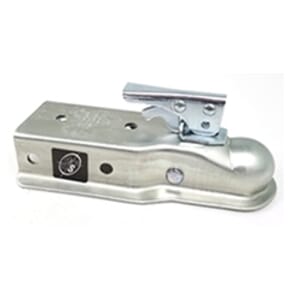
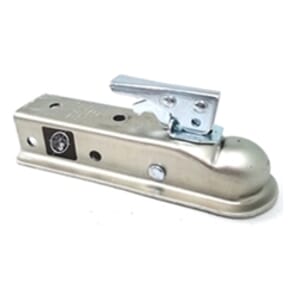
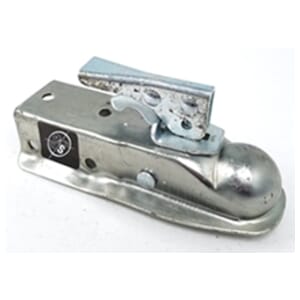
- Straight tongue coupler: A coupler that slides over the end of a single straight tongue. Its channel width has to match the tongue, such as 2 in., 2-1/2 in. or 3 in.
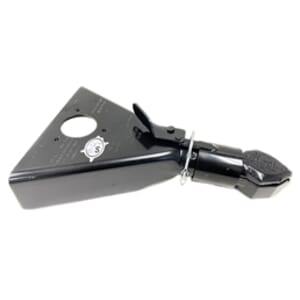
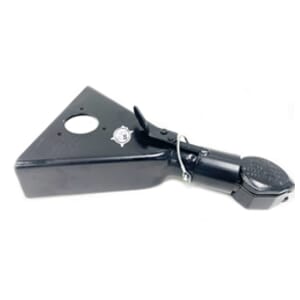
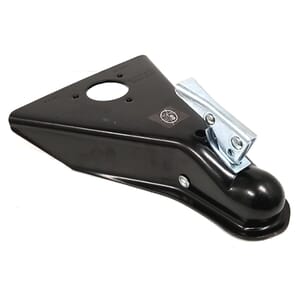
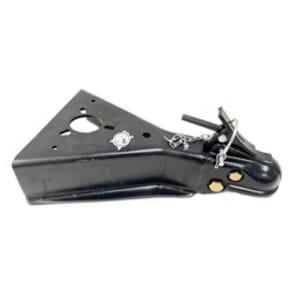
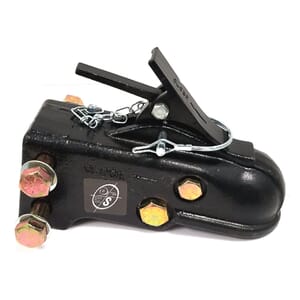
- A-frame coupler: A coupler that sits where the two rails of a V-shaped tongue meet. Most of the A-frame couplers we carry are listed for 50-degree A-frames.
- Adjustable (channel mount) coupler: A coupler that bolts to a channel bracket with several bolt positions, so the coupler height can be changed to level the trailer.
- Internal stop: The stop inside a straight tongue coupler. RAM says to butt it against the end of the tongue for maximum overlap.
- Fillet weld: A weld laid in the corner where two pieces meet. RAM gives the fillet weld size for each coupler type.
- Latch: The lever, sleeve or handle that locks the coupler onto the ball. Some latches can be replaced without replacing the coupler.
Repair or replace the coupler?
RAM's instructions start with this: "Check vehicle hitch, ball and coupler for signs of wear or damage. Replace any parts that are worn or damaged before towing." Here is how that usually sorts out:
- Replace the coupler if the body is cracked, bent or rusted through, the ball socket is worn, the welds or bolt holes are damaged, or the coupler is the wrong ball size or capacity for the trailer.
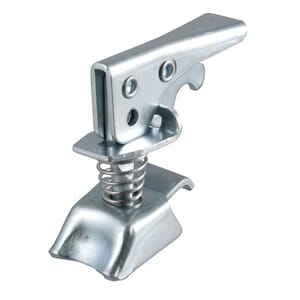
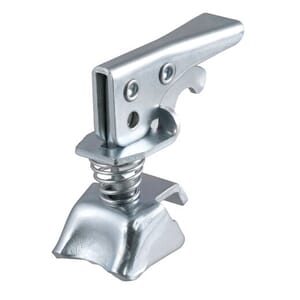
- A latch may be enough if the body is sound and only the latch is worn or broken. Replacement latches are made for specific couplers. For example, CURT's replacement 1-7/8 in. Posi-Lock latch is listed in CURT's catalog for its 1-7/8 in. straight tongue couplers (25105, 25128 and 25131), and the replacement 2 in. Posi-Lock latch for its 2 in. straight tongue couplers (25153, 25135, 25138 and 25100). Browse coupler replacement parts.
- Adjust before you replace a lever latch coupler that is loose on the ball. RAM's lever latch repair sheet has you tighten the nut until the latch is hard to close with the correct ball in the socket, then back it off a half to three quarter turn, so the latch closes with less effort and the ball can still pivot in the socket. RAM adds that there should never be less than a full thread showing on the spade bolt below the nut.
Bolt-on vs weld-on: how to tell what you have
Look at where the coupler meets the tongue:
- Bolts through the sides of a straight coupler: It is bolted. You can usually unbolt it and bolt on a new coupler of the same ball size, capacity and channel width.
- A weld bead around the coupler body: It is welded. The old coupler has to be cut or ground off, and the new one welded on, unless you change to a bolt-on design that fits your tongue.
- A coupler bolted to a tall channel with several holes: It is an adjustable coupler. The coupler unbolts from the channel, and the channel itself is welded to the tongue.
| Coupler type | Usual mounting | What the instructions say |
|---|---|---|
| Straight tongue | Bolt-on or weld-on | RAM: bolts through the side holes are the preferred method; a 1/8 in. fillet weld is also shown. CURT: bolt-on or weld-on installation, trailer mounting hardware not included. |
| A-frame | Usually weld-on; bolt-on models are made | RAM: weld all contact points on the outer coupler body to the trailer frame, both sides. Demco: EZ-Latch couplers come in weld on or bolt on A-frame mounts. |
| Adjustable (channel mount) | Coupler bolts to a welded channel | RAM: gussets on both sides of the channel where it meets the tongue; coupler bolts to the channel with the grade 8 hardware provided. |
Both methods work when they are done to the maker's instructions. A bolt-on coupler is easier to change later. A weld-on coupler needs welding skill and equipment, but there are no bolts to check for tightness.
What to write down before you order
- Ball size: Read it off the old coupler. RAM says to use only the ball diameter indicated on the coupler, because any other ball diameter can let the coupler and ball separate.
- Capacity: Know your trailer plus load weight. RAM says not to exceed the lesser of the coupler, vehicle, ball or trailer weight ratings. If the trailer has been loaded heavier than the old coupler's rating, step up.
- Tongue type and size: For a straight tongue, measure the tongue width so the channel matches, such as 2 in., 2-1/2 in. or 3 in. For an A-frame, check the angle between the rails; most of the A-frame couplers we carry are listed for 50 degrees. For an adjustable coupler, note the channel width. RAM's adjustable couplers are set up for an industry standard 3 in. wide channel.
- Bolt-on or weld-on: Decide whether you are keeping the same mounting or changing it.
- Jack mount: If the A-frame jack mounts through the coupler, the new coupler has to take the same jack. RAM's 15,000 lb. cast head A-frame coupler is made to receive a 2-1/4 in. outer tube round jack.
- Latch style: Lever, sleeve lock or other latch. If you use a coupler lock, measure the latch span so the lock fits the new coupler.
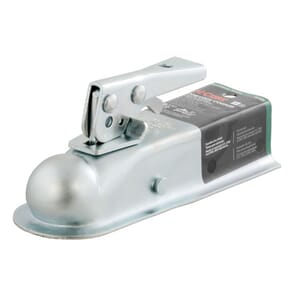
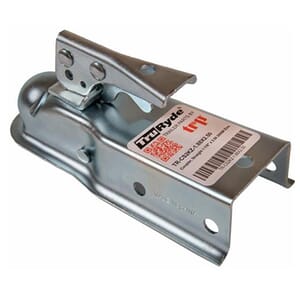
Examples of straight tongue couplers by size: the RAM zinc straight tongue coupler for a 1-7/8 in. ball and 2 in. channel, the RAM zinc coupler for a 2 in. ball and 2 in. channel, the RAM zinc coupler for a 2 in. ball and 3 in. channel, the TruRyde 2 in. zinc straight tongue coupler for a 2 in. channel, 3,500 lbs. and the TruRyde 2 in. zinc straight tongue coupler for a 3 in. channel, 5,000 lbs. Shop all straight tongue couplers.
Removing the old coupler
- Support the trailer. Unhook from the truck, chock the wheels and support the tongue so it cannot drop when the coupler comes off. If the tongue jack is mounted through the coupler, support the tongue separately before you take the jack off.
- Disconnect what is attached. Unclip the safety chains and the wiring if either is fastened to the coupler, and move anything that could be damaged by heat or sparks.
- Bolted couplers: Remove the nuts and bolts and slide the coupler off the tongue. Plan on new hardware for the new coupler.
- Welded couplers: The welds have to be cut or ground away without cutting into the tongue. This is a job for someone with the right equipment and experience. Check the tongue end afterward for cracks, thin metal or rust. A damaged tongue needs repair before any coupler goes on.
- Adjustable couplers: Remove the two bolts that hold the coupler to the channel. Check the channel and its welds and gussets. If the channel is cracked, bent or the holes are worn, replace the channel too.
Installing a straight tongue coupler
RAM's coupler instruction sheet covers straight tongue couplers by class. Butt the coupler's internal stop against the end of the trailer tongue for maximum overlap, then fasten it.
| Coupler class | Preferred (bolted) | Alternate (bolted) | Weld shown |
|---|---|---|---|
| Class 1 | Bolts through the side holes, torqued to 15-20 ft. lbs. | Two 3/8 in. grade 5 through bolts and lock nuts, torqued to at least 20 ft. lbs. without excessive deformation of the coupler or tongue | 1/8 in. fillet weld |
| Class 2 and class 3 | Four 1/2 in. bolts through the side holes, torqued to 30-35 ft. lbs. | Two 1/2 in. grade 5 through bolts and lock nuts, torqued to at least 35 ft. lbs. without excessive deformation of the coupler or tongue | 1/8 in. fillet weld |
Table note: for the welds, RAM lists No. E6011 A.W.S. welding rod, 1/8 in. diameter, with the machine set at 105-115 amps and 18-22 volts. In CURT's catalog, class 1 straight tongue couplers are the 2,000 lb. 1-7/8 in. ball models, class 2 are 3,500 lb. 2 in. ball models, and class 3 is 5,000 lb. with a 2 in. ball and 3 in. channel. If you are not sure which class your coupler is, check with its maker or call us.
- Use the hardware size and torque for your coupler's class. If the coupler or tongue starts to deform before the bolts reach torque, stop and find out why.
- Use a coupler with the same channel width as the tongue.
- A CURT example: the CURT 1-7/8 in. straight tongue coupler with Posi-Lock for a 2 in. channel, 2,000 lbs. CURT lists it as class 1.
Installing an A-frame coupler
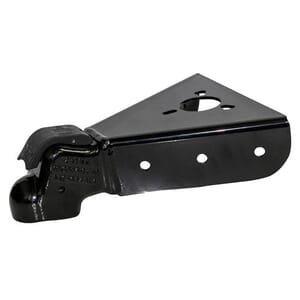
RAM's A-frame coupler instructions say to slide the coupler back so its internal stop is butted against the end of the trailer tongue for maximum overlap, then "weld all contact points on outer coupler body to trailer frame," on both sides of the coupler.
- Weld size: RAM calls for a 1/8 in. fillet weld on 5K and 7K capacity A-frame couplers, and a 5/32 in. fillet weld on 10K and greater.
- Examples (weld-on): the RAM 2 in. ball 5,000 lbs. 50-degree stamped A-frame top latch coupler, the RAM 2 in. 7,000 lbs. sleeve lock A-frame coupler, the RAM 2-5/16 in. 12,500 lbs. sleeve lock A-frame coupler and the 2-5/16 in. heavy duty 50-degree weld-on A-frame coupler, which RAM makes to receive a 2-1/4 in. outer tube round jack. RAM's sleeve lock couplers include a pin and lanyard assembly.
- Bolt-on option: If you would rather not weld, a bolt-on A-frame coupler such as the Demco black bolt-on 2 in. EZ-Latch 50-degree A-frame coupler may fit. Demco lists it as a cast A-frame bolt-on coupler. Follow Demco's instructions for the hardware and torque, and make sure your A-frame matches its 50-degree mount.
Shop all A-frame couplers.
Installing an adjustable (channel mount) coupler
An adjustable coupler has two parts: the channel, which is welded to the tongue, and the coupler, which bolts to the channel.
- The channel: RAM says the U channel is to have gussets on both sides where it meets the trailer tongue, running the entire length of the channel. RAM adds that weld size, gusseting, channel height and orientation depend on the trailer design, and that it is the trailer manufacturer's responsibility to make sure the gusseting is sufficient. If you are adding a channel to a trailer that did not have one, have a qualified welder or trailer shop do it.
- The coupler: RAM says to fasten the coupler to the bracket with two 5/8 in. diameter SAE grade 8 bolts and the lock nuts provided with the coupler, torqued to 100-110 ft. lbs.
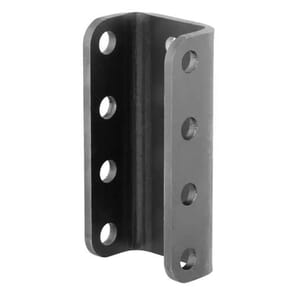
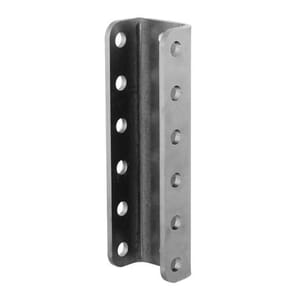
- Positions: RAM's channels come in a 4 hole, 3 position version and a 6 hole, 5 position version. Set the coupler at the position that keeps the trailer level when hooked up.
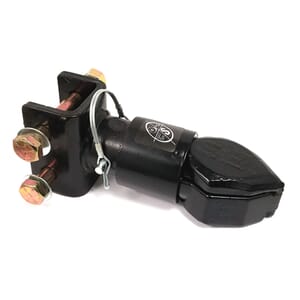
- Examples: the RAM 2 in. sleeve lock adjustable coupler, the RAM 2-5/16 in. heavy duty precision cast head adjustable coupler and the RAM 5 position channel and 2 in. sleeve lock adjustable coupler, which comes with the channel.
- Replacing the channel: CURT lists the CURT adjustable coupler channel, 3 in. I.D., 7-1/2 in. high (3 position) and the CURT adjustable coupler channel, 3 in. I.D., 11-3/4 in. high (5 position), both with holes 2 in. on center. Before pairing a channel with a coupler, make sure the inside width and hole spacing match the coupler. Browse channels.
Shop sleeve lock adjustable channel mount couplers and adjustable height cast head couplers.
After the install: check, latch and lock
- Check the coupler works. RAM: "After installation is complete check that coupler operation has not been impaired in any way." Open and close the latch on the correct size ball before you tow.
- Latch it all the way. RAM's diagram reads "Coupler must be latched down completely" and "Ball clamp must be on bottom curve of hitch ball." On sleeve lock couplers, slide the sleeve all the way forward over the movable cap and install the pin and lanyard.
- Connect the rest. RAM says to check that the safety chains are properly connected and that all trailer lighting is hooked up and working.
- Recheck after the first trip. RAM's coupler sheet says to recheck tightness again after towing about 50 miles. Check the mounting bolts on a bolt-on coupler at the same time.
- Keep it maintained. RAM: "Smear ball socket with chassis grease. Periodically oil pivot points and sliding surfaces of coupler with SAE 30 wt. motor oil." When the trailer is parked, keep the coupler off the ground so dirt does not build up in the ball socket.
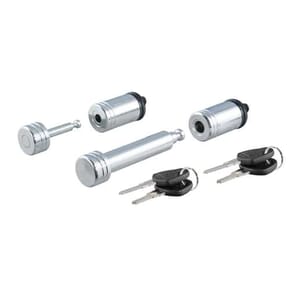
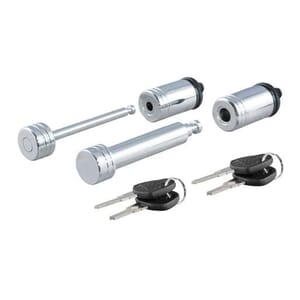
- Lock it. A new coupler may have a different latch span than the old one. CURT's hitch and coupler lock sets are keyed alike, with a hitch lock for a 2 in. x 2 in. receiver: the CURT hitch and coupler lock set with a 7/8 in. latch span and the CURT hitch and coupler lock set with a 2-1/2 in. latch span. Browse CURT hitch and coupler lock sets and all coupler locks.
Frequently asked questions
Can I bolt on a coupler instead of welding it?
Often, yes. RAM shows bolts through the side holes as the preferred method for its straight tongue couplers, and CURT lists its straight tongue and A-frame couplers for bolt-on or weld-on installation. Bolt-on A-frame couplers are also made, such as the Demco EZ-Latch cast A-frame bolt-on coupler. Follow the coupler maker's instructions for the hardware and torque.
What size bolts hold a straight tongue coupler?
RAM's sheet calls for four 1/2 in. bolts torqued to 30-35 ft. lbs. on class 2 and class 3 couplers, or two 1/2 in. grade 5 through bolts and lock nuts torqued to at least 35 ft. lbs. For class 1 couplers, the bolts go to 15-20 ft. lbs., or two 3/8 in. grade 5 through bolts and lock nuts to at least 20 ft. lbs.
How should an A-frame coupler be welded?
RAM says to butt the internal stop against the end of the tongue and weld all contact points on the outer coupler body to the trailer frame, on both sides. Use a 1/8 in. fillet weld for 5K and 7K couplers and a 5/32 in. fillet weld for 10K and greater. If you are not sure, have a qualified welder do it.
Do I have to replace the channel on an adjustable coupler?
Not if it is in good shape. The coupler unbolts from the channel. RAM uses two 5/8 in. SAE grade 8 bolts and lock nuts torqued to 100-110 ft. lbs. Replace the channel if it is cracked, bent or the holes are worn.
Can I put a bigger coupler on my trailer?
A higher rated coupler does not raise the trailer's rating. RAM says never to exceed the lesser of the coupler, vehicle, ball or trailer weight ratings. Match the ball size on the new coupler, and use only that size ball.
Can I just replace the latch?
If the coupler body is sound, sometimes. Replacement latches are made for specific couplers, such as CURT's Posi-Lock latches for its straight tongue couplers. If the body is cracked, bent or worn, replace the coupler.
How do I know the new coupler is on right?
RAM says to check that coupler operation has not been impaired, that the coupler is latched down completely with the ball clamp on the bottom curve of the ball, and to recheck tightness after towing about 50 miles.
References
RAM (Pacific Rim International) A-Frame Coupler Installation, Maintenance and Latching Instructions, rev. 03/23 (internal stop, weld all contact points, fillet weld sizes by capacity, maintenance). RAM Coupler Installation, Maintenance and Proper Latching Instructions sheet (straight tongue couplers by class, bolt sizes and torque, weld rod and machine settings, latching diagram, recheck after about 50 miles). RAM Adjustable Coupler Installation, Maintenance and Latching Instructions, rev. 07/25 (channel gussets, 5/8 in. grade 8 bolts, 100-110 ft. lbs., 3 and 5 position channels). RAM Lever Latch Coupler Repair Installation Sheet (latch adjustment). RAM Bumper Pull Coupler Catalog, October 2026 (straight tongue, A-frame and adjustable coupler lines; 3 in. channel). CURT aftermarket catalog (straight tongue and A-frame couplers, bolt-on or weld-on installation, classes and ratings; Posi-Lock replacement latches; adjustable coupler channels; hitch and coupler lock sets). Demco 2026 Trailer Components Catalog (EZ-Latch mounting configurations; cast A-frame bolt-on coupler). Southwest Wheel product and category listings.
Related guides
- How to Choose a Trailer Coupler: Ball Size, Tongue Type, Latch and Capacity
- Trailer Jack Types: A-Frame, Swivel, Drop Leg and Square Tube, and How to Size One
- Trailer D-Rings and Safety Chains: What Working Load Limit Means and How to Choose by Size and Grade
- How Surge Brake Actuators Work and How to Pick One
- Trailer Hitch Classes 1 to 5 Explained: Receiver Size, GTW and Tongue Weight
- Choosing Trailer Axle Capacity: Hitch Weight, GAWR, Wheels and Tires
Find the right replacement coupler
Have the ball size, capacity, tongue type and tongue or channel width ready when you shop or call, and tell us whether the old coupler is bolted or welded. A photo of the old coupler helps too. Southwest Wheel has supplied trailer parts for 107 years, and we can help you match a coupler, latch, channel or lock to your trailer.
Need a specific style? See straight tongue couplers, A-frame couplers, adjustable channel mount couplers and coupler replacement parts.
Call Southwest Wheel at 1-800-866-3336.
Southwest Wheel - Your Trailers Best Friend Since 1919.


