


Your shopping cart is currently empty.
Trailer Hitch Classes 1 to 5 Explained: Receiver Size, GTW and Tongue Weight
Every receiver hitch has a class, from Class 1 for small cars up to Class 5 for heavy-duty pickups. The class tells you two things at a glance: the size of the receiver opening and about how much weight the hitch is built to pull. Pick the wrong class and you end up with a ball mount that will not fit the receiver, or a hitch that is not rated for the trailer behind it.
This guide walks through trailer hitch Classes 1 to 5 using the CURT trailer hitch catalog: the receiver size and weight ratings for each class, what gross trailer weight and tongue weight mean, how weight distribution changes the numbers, and how to match the ball mount, ball and hitch pin to the hitch. It also covers B&W receiver hitches and Tow & Stow adjustable ball mounts, which B&W rates by gross trailer weight and vertical tongue weight rather than CURT's Class 1 to 5 labels. Use this as an overview, and go by the label on the hitch and the listing for the exact part.
Key takeaways
- The receiver size tells you the class group, not the exact rating. In the CURT catalog, Class 1 and 2 hitches use a 1-1/4 in. receiver. Class 3, 4 and Class 5 Xtra Duty use a 2 in. receiver. Class 5 Commercial Duty uses a 2-1/2 in. receiver. The same receiver size does not make every ball mount in that opening interchangeable for the load.
- Each class has a top rating, not one rating. CURT says weight ratings vary by part number within a class, so check the exact hitch.
- The lowest-rated part sets the limit. Your hitch, ball mount, ball, coupler, trailer and vehicle each have a rating. You can only tow up to the lowest one.
- Tongue weight should be about 10 to 15 percent of the trailer weight. That is CURT's guideline for proper tongue weight. If you use a scale, use one capable of the estimated tongue weight and follow a rated setup.
- Weight distribution can raise a rating only when that hitch and vehicle allow it. CURT's class table lists a top weight-distribution rating for some Class 3, 4 and 5 hitches. Do not treat that top figure as a general increase. Class 1 and 2 hitches have no weight-distribution rating in the catalog.
- The vehicle still has the final say. CURT notes that hitch ratings are limited to the vehicle manufacturer's stated capacities.
Terms used in this guide
- Receiver hitch: The hitch bolted or welded under the vehicle, with a square tube (the receiver) that the ball mount slides into.
- Receiver size: The inside size of the square opening: 1-1/4 in., 2 in. or 2-1/2 in.
- Gross trailer weight (GTW): The total weight of the trailer and everything on it. CURT's example: boat plus trailer plus cooler plus fishing gear.
- Tongue weight (TW): The downward force of the trailer tongue on the ball. B&W also uses vertical tongue weight (VTW) for the same kind of downward load.
- Weight carrying: Towing with just the hitch and ball mount, with no weight distribution system.
- Weight distribution (WD): A hitch system that spreads part of the tongue weight across the vehicle and trailer to help them ride level. A WD rating is the most that hitch is rated to tow with a weight-distribution system installed, and only if that hitch and the vehicle allow it.
- Ball mount: The bar with a shank that slides into the receiver and holds the hitch ball. Its drop or rise sets the ball height.
Hitch classes 1 to 5 at a glance
CURT sorts its custom-fit hitches into five classes by receiver size and weight rating. These are the top ratings for each class in the CURT catalog's quick comparison. A given hitch can be rated lower than the top of its class. The weight-distribution column is also a class top, not a rating you can assume for every hitch in that class.
| Hitch class | Receiver size | Gross trailer weight (up to) | Tongue weight (up to) | With weight distribution (up to) |
|---|---|---|---|---|
| Class 1 | 1-1/4 in. | 2,000 lbs. | 200 lbs. | Not rated |
| Class 2 | 1-1/4 in. | 3,500 lbs. | 350 lbs. | Not rated |
| Class 3 | 2 in. | 8,000 lbs. | 800 lbs. | 12,000 lbs. / 1,200 lbs. tongue |
| Class 4 | 2 in. | 10,000 lbs. | 1,000 lbs. | 12,000 lbs. / 1,200 lbs. tongue |
| Class 5 Xtra Duty | 2 in. | 17,000 lbs. | 2,550 lbs. | 17,000 lbs. / 2,550 lbs. tongue |
| Class 5 Commercial Duty | 2-1/2 in. | 20,000 lbs. | 2,700 lbs. | 20,000 lbs. / 2,700 lbs. tongue |
Two things stand out. First, you cannot tell Class 1 from Class 2, or Class 3 from Class 4, by the receiver alone, so read the label on the hitch. Second, the receiver size is what decides which shank will physically fit. A 2 in. shank will not go into a 1-1/4 in. receiver. Fitting the opening is not the same as being rated for the load: match the ball mount class and rating to the hitch and the trailer.
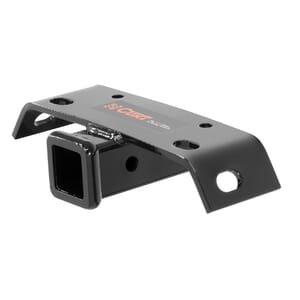
CURT also makes front mount hitches with a 2 in. receiver, rated up to 5,000 lbs. gross trailer weight and 500 lbs. tongue weight in the catalog, and up to 9,000 lbs. straight-line pull. CURT lists them for attaching a snow plow, cargo carrier or other accessory, and for moving a trailer into a tight spot. Straight-line pull is not the same as gross trailer weight.
Class 1 and Class 2 hitches: 1-1/4 in. receiver
In our CURT listings, Class 1 and Class 2 hitches are mostly made for cars, crossovers and minivans. They use the 1-1/4 in. receiver and are rated for light loads: up to 2,000 lbs. for Class 1 and up to 3,500 lbs. for Class 2, with no weight distribution rating.
- Custom-fit hitches: Made for one vehicle. Look up your vehicle in Class 1 trailer hitches or Class 2 trailer hitches.
- Multi-fit: The CURT Class 2 multi-fit hitch with a 1-1/4 in. receiver fits a range of vehicles and is rated 3,500 lbs. gross trailer weight and 350 lbs. tongue weight in CURT's multi-fit application guide.
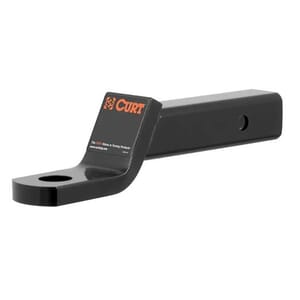
- Ball mounts: CURT lists its Class 1 and Class 2 ball mounts as fitting a 1-1/4 in. receiver, with a 3/4 in. hole for the ball shank. That shared receiver size does not make them interchangeable for the load. A Class 1 mount does not become a Class 2 mount just because it slides into a Class 2 hitch, and a Class 2 mount does not raise a Class 1 hitch's rating. The Class 1 ball mount with a 1-1/4 in. drop is rated 2,000 lbs. / 200 lbs. tongue weight, and the Class 2 ball mount with a 1 in. drop is rated 3,500 lbs. / 350 lbs. tongue weight.
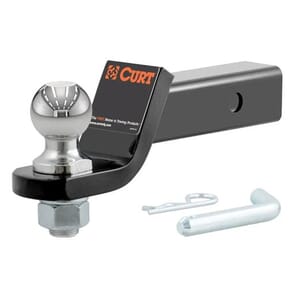
- Starter kit: The CURT towing starter kit with a 2 in. ball comes with the ball already on a 1-1/4 in. shank ball mount with a 3-1/4 in. drop, rated 3,500 lbs.
- Hitch pin: A 1-1/4 in. receiver takes a 1/2 in. hitch pin.
Class 3 and Class 4 hitches: 2 in. receiver
Class 3 and Class 4 hitches both use the 2 in. receiver, so a 2 in. shank is what fits the opening. The difference is the class rating: up to 8,000 lbs. for Class 3 and up to 10,000 lbs. for Class 4 when weight carrying. The CURT class table lists a top weight-distribution rating of up to 12,000 lbs. gross trailer weight and 1,200 lbs. tongue weight for both classes. Use a weight-distribution rating only if the exact hitch is rated for it and the vehicle allows it.
- Custom-fit hitches: Shop by vehicle in Class 3 trailer hitches or Class 4 trailer hitches. One example is the CURT Class 4 hitch for select Chevrolet Silverado and GMC Sierra 1500 and 2500 trucks. CURT rates it 10,000 lbs. gross trailer weight and 1,000 lbs. tongue weight, and 12,000 lbs. / 1,200 lbs. with weight distribution. Those figures are still limited to the vehicle manufacturer's stated capacities.
- Multi-fit: The CURT 13900 Class 3 multi-fit hitch is listed at 5,000 lbs. / 500 lbs. in CURT's multi-fit application guide, with no weight-distribution rating in that guide. The CURT 13902 Class 3 multi-fit hitch, which CURT calls a comprehensive retail option for pickups, is listed at 8,000 lbs. / 800 lbs., and 12,000 lbs. / 1,200 lbs. with weight distribution.
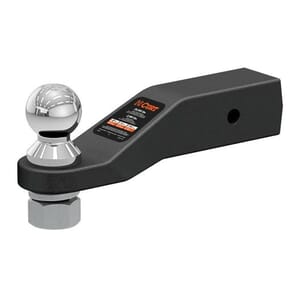
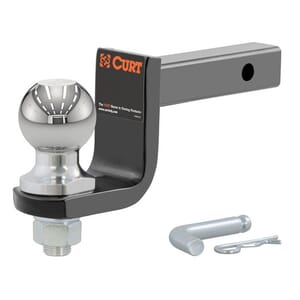
- Ball mounts: The CURT loaded ball mount with a 2 in. ball and 2 in. drop fits a 2 in. receiver and is rated 7,500 lbs. For more weight, the CURT Class 4 ball mount with a 2 in. drop is rated 10,000 lbs. and has a 1-1/4 in. hole for the ball shank. A higher-rated 2 in. mount does not raise the rating of a lower-rated hitch.
- Hitch pin: A 2 in. receiver takes a 5/8 in. hitch pin.
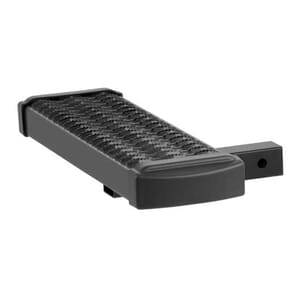
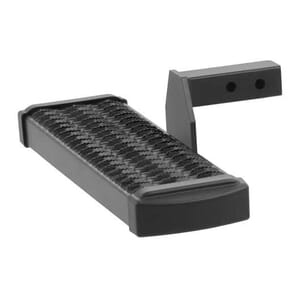
A 2 in. receiver is also where most hitch accessories fit. The CURT Grip Step hitch step slides into any 2 in. receiver and gives a 26 in. wide step, and the Grip Step with a 6 in. drop sits lower for taller trucks (CURT says to use it in the drop position only). Both include a hitch pin and clip. A step is not a towing part, so it does not change the hitch rating.
Class 5 hitches: Xtra Duty and Commercial Duty
Class 5 hitches are built for heavy-duty pickups and work trucks. CURT makes them in two types. The figures below are the class tops in the CURT catalog. Confirm the rating on the exact hitch, and use a weight-distribution rating only if that hitch and the vehicle allow it.
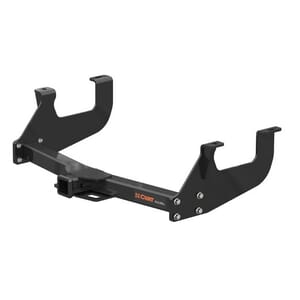
- Class 5 Xtra Duty: 2 in. receiver, rated up to 17,000 lbs. gross trailer weight and 2,550 lbs. tongue weight, with the same top rating listed with weight distribution. Because the receiver is 2 in., it takes the same shank size as a Class 3 or 4, but the ball mount still has to be rated for the load. Example: the CURT Xtra Duty Class 5 hitch for select Chevrolet, GMC, Dodge and Ram trucks. CURT rates it 17,000 lbs. gross trailer weight and 2,550 lbs. tongue weight, with the same rating with weight distribution. Those figures are still limited to the vehicle manufacturer's stated capacities. Shop all of them in Class 5 Xtra Duty trailer hitches.
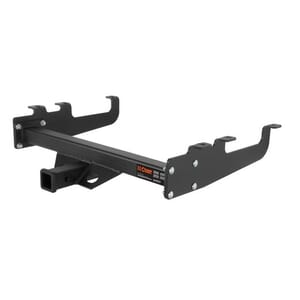
- Class 5 Commercial Duty: 2-1/2 in. receiver, rated up to 20,000 lbs. gross trailer weight and 2,700 lbs. tongue weight. Example: the CURT Commercial Duty Class 5 hitch with a 2-1/2 in. receiver for select Chevy, GMC, Dodge and Ram trucks. CURT rates it 20,000 lbs. gross trailer weight and 2,700 lbs. tongue weight, with the same rating with weight distribution. Those figures are still limited to the vehicle manufacturer's stated capacities. Shop all of them in Class 5 Commercial Duty trailer hitches.
A 2-1/2 in. receiver needs a ball mount with a 2-1/2 in. shank, such as the CURT forged ball mount with a 2-5/16 in. ball and 2-1/2 in. shank, rated 20,000 lbs. and 2,000 lbs. tongue weight in the catalog. The pin is still 5/8 in. in diameter. What changes is the length: the tube is larger, so you need a longer 5/8 in. pin made for a 2-1/2 in. or 3 in. receiver, such as the CURT heavy-duty 5/8 in. hitch pin for 2-1/2 in. or 3 in. receivers.
Class 5 hitches have large safety chain openings for heavy-duty hooks. For safety chain and hook sizing, see our guide to trailer D-rings and safety chains below.
Multi-fit, weld-on and bumper hitches
Not every hitch is made for one vehicle. CURT also makes hitches that fit a range of vehicles. They are still sorted by class and rating:
- Multi-fit hitches: For when a custom hitch is not available. Most need little or no drilling, and CURT rates them from 3,500 lbs. up to 15,000 lbs. CURT notes that only select models are compatible with weight-distribution hitches. The CURT Class 5 multi-fit hitch with a 2 in. receiver is listed at 15,000 lbs. / 1,500 lbs., and 16,000 lbs. / 1,600 lbs. with weight distribution, which is below the 17,000 lb. Xtra Duty class top. See all multi-fit trailer hitches.
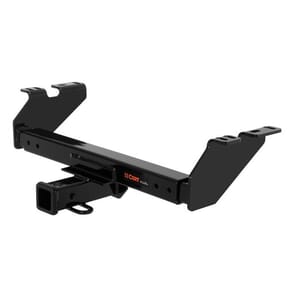
- Universal weld-on hitches: For service body trucks and other large pickups. The frame adjusts and the side plates are welded on, so installation needs a welder. The CURT universal weld-on hitch with a 2 in. receiver for 18 in. to 43 in. frames is rated 15,000 lbs. CURT says to sand the weld locations before welding. See all weld-on trailer hitches.
- Bumper hitches: The CURT bumper hitch with a 2 in. receiver bolts onto the bottom of most factory steel step bumpers and is rated 5,000 lbs. / 500 lbs. A 2 in. receiver does not make it a Class 3 hitch; go by its rating.
Fifth wheel and gooseneck hitches mount in the truck bed and are not part of the Class 1 to 5 receiver system. They are sold separately as CURT fifth wheel hitches and CURT gooseneck hitches.
B&W receiver hitches and adjustable ball mounts
B&W also makes bumper-pull receiver hitches and ball mounts. The B&W catalog does not sort these into CURT's Class 1 to 5 labels. It publishes gross trailer weight and vertical tongue weight for the hitch or mount. As with any setup, you can only tow up to the lowest-rated part, including the vehicle.
- 16K heavy-duty receiver hitch: The B&W catalog rates this hitch at 16,000 lbs. gross trailer weight and 1,600 lbs. vertical tongue weight, with a 2 in. receiver tube. B&W describes a fully welded, bolt-on hitch with minimal to no drilling, a six-point frame mount, and safety chain openings in a steel gusset. Shop B&W heavy-duty receiver hitches, or go by vehicle in Chevy/GMC, Ford or Dodge/Ram.
- Tow & Stow adjustable ball mounts: These mounts let you swap ball sizes, adjust the height, and stow the mount under the vehicle when you are not towing. In the B&W catalog, a 2 in. shank is rated 10,000 lbs. gross trailer weight and 1,000 lbs. vertical tongue weight; a 2-1/2 in. shank is rated 18,000 lbs. / 1,800 lbs.; and a 3 in. shank is rated 21,000 lbs. / 2,100 lbs. The shank still has to match the receiver, and the mount rating cannot exceed what the hitch and vehicle allow. Shop Tow & Stow adjustable ball mounts.
- Heavy-duty and triple-tow mounts: B&W heavy-duty ball mounts are listed at 16,000 lbs. gross trailer weight and 1,600 lbs. vertical tongue weight in the catalog. The Triple Tow ball mount is listed at 10,000 lbs. / 1,000 lbs., with ball ratings of 3,500 lbs. for the 1-7/8 in. ball, 7,500 lbs. for the 2 in. ball, and 10,000 lbs. for the 2-5/16 in. ball. See B&W heavy-duty ball mounts and the B&W Triple Tow ball mount.
- Weight distribution: If you need a weight-distribution system, confirm that the exact hitch, mount and vehicle are rated for it. See B&W weight distribution hitches.
B&W also makes bed-mounted gooseneck and fifth-wheel hitches, including Turnoverball, Companion and Patriot, which are not part of the Class 1 to 5 receiver system. Those are in separate categories from the receiver hitches above.
Match the ball mount, ball and pin to the hitch
The hitch is only one part of the connection. CURT says towing capacity is always limited to the lowest-rated towing component. A Class 4 hitch with a 3,500 lb. ball mount is a 3,500 lb. setup. The same is true if the hitch is the lower-rated part.
| Receiver size | CURT hitch classes | Ball mount shank | Hitch pin |
|---|---|---|---|
| 1-1/4 in. | Class 1, Class 2 | 1-1/4 in. | 1/2 in. |
| 2 in. | Class 3, Class 4, Class 5 Xtra Duty | 2 in. | 5/8 in. |
| 2-1/2 in. | Class 5 Commercial Duty | 2-1/2 in. | 5/8 in., longer pin for the larger tube |
Check each piece:
- Ball mount: The shank must match the receiver, and the rating must cover your trailer. A Class 1 mount and a Class 2 mount can share a 1-1/4 in. shank and still have different ratings, so do not treat them as interchangeable. Browse CURT ball mounts or the B&W mount categories above.
- Hitch ball: The ball diameter must match the trailer coupler, the ball shank must fit the hole in the ball mount, and the ball has its own rating. Browse CURT trailer balls.
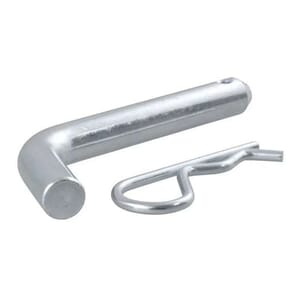
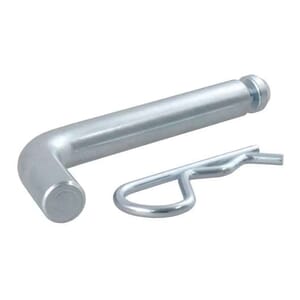
- Hitch pin: Use the pin size made for the receiver. A 2 in. receiver and a 2-1/2 in. receiver both use a 5/8 in. diameter pin; the 2-1/2 in. and 3 in. pin is longer so it can span the larger tube, not a larger diameter. Browse hitch pins and clips.
- Coupler, chains and trailer: These have ratings too. Our coupler and safety chain guides below cover them.
Getting the drop right. The ball mount's drop or rise sets the ball height so the trailer tows level. CURT's method: with the trailer level, measure from the ground to the top of the receiver opening and from the ground to the bottom of the trailer coupler. Subtract the receiver height from the coupler height. A negative number is the drop you need; a positive number is the rise. CURT warns that a trailer that is not level can wander or sway.
How to pick a hitch class, step by step
- Find your gross trailer weight. Weigh the loaded trailer, or add up the trailer and everything you will carry on it. Plan for the heaviest load, not the empty trailer.
- Work out the tongue weight. CURT says proper tongue weight is about 10 to 15 percent of the gross trailer weight. A 5,000 lb. trailer should have about 500 to 750 lbs. on the ball. CURT says tongue weight can be measured with a commercial scale or a bathroom scale, but only with a scale capable of the estimated tongue weight, and only by following the catalog method: use the pipe-and-brick setup in the CURT towing-basics diagram, then multiply the scale reading by three. Do not rest a heavy tongue directly on a bathroom scale.
- Check the vehicle's towing capacity. Your owner's manual sets the top limit. A hitch rated higher than the vehicle does not raise what the vehicle can tow.
- Pick the class that covers both numbers. Use the table above, then confirm the rating of the exact hitch, since ratings vary by part number.
- Decide on weight distribution only if the exact hitch and vehicle allow it. If your trailer is near the weight-carrying limit of a Class 3, 4 or 5 hitch that is actually rated for weight distribution, a weight-distribution hitch may be used up to that hitch's WD rating and can help the vehicle and trailer ride level. Do not assume every hitch in the class gets the class-top WD figure. See CURT weight distribution hitches or B&W weight distribution hitches.
- Match the rest of the setup. Ball mount, ball, pin, coupler and safety chains should all be rated for the load and sized for the receiver and coupler.
Frequently asked questions
What is the difference between a Class 3 and a Class 4 hitch?
Both use a 2 in. receiver. In the CURT catalog, Class 3 is rated up to 8,000 lbs. and Class 4 up to 10,000 lbs. when weight carrying. The class table lists a top weight-distribution rating of up to 12,000 lbs. for both, but that applies only if the exact hitch has a weight-distribution rating and the vehicle allows it.
Can I put a 2 in. ball mount in a 1-1/4 in. receiver?
No. The shank has to match the receiver. A 1-1/4 in. receiver (Class 1 or 2) takes a 1-1/4 in. shank ball mount.
Can I use a Class 2 ball mount in a Class 1 hitch, or the other way around?
CURT lists both mounts as fitting a 1-1/4 in. receiver, but they are not interchangeable for the load. A Class 1 mount is rated 2,000 lbs. even in a Class 2 hitch. A Class 2 mount does not raise a Class 1 hitch's rating. Use a mount rated for the hitch and the trailer, and stay at the lowest-rated part.
Does a bigger ball mount let me tow more with a Class 2 hitch?
No. You can only tow up to the lowest-rated part. A Class 2 hitch rated 3,500 lbs. stays a 3,500 lb. setup even with a higher-rated ball mount.
How much tongue weight should my trailer have?
CURT's guideline is about 10 to 15 percent of the gross trailer weight. If you measure it with a scale, use a scale capable of the estimated tongue weight and follow CURT's rated setup. Do not set a heavy tongue directly on a bathroom scale.
Can I use weight distribution with a Class 1 or Class 2 hitch?
CURT lists no weight distribution rating for Class 1 or Class 2 hitches. Weight distribution ratings start at Class 3, and only for hitches that are actually given a WD rating.
What is the difference between Class 5 Xtra Duty and Commercial Duty?
Xtra Duty uses a 2 in. receiver and is rated up to 17,000 lbs. Commercial Duty uses a 2-1/2 in. receiver and is rated up to 20,000 lbs. They need different size ball mounts. The hitch pin diameter stays 5/8 in.; the Commercial Duty pin is longer for the larger tube.
Is a front mount hitch the same as a rear hitch?
No. CURT front mount hitches use a 2 in. receiver and are rated up to 5,000 lbs. gross trailer weight and 500 lbs. tongue weight, with a separate catalog figure of up to 9,000 lbs. straight-line pull. CURT lists them for accessories like snow plows and cargo carriers, and for moving a trailer into a tight spot.
Does B&W use the same Class 1 to 5 system?
Not in the B&W catalog we used. B&W rates its 16K heavy-duty receiver hitch at 16,000 lbs. gross trailer weight and 1,600 lbs. vertical tongue weight, and it rates Tow & Stow mounts by shank size rather than by CURT class labels. Compare the published ratings, and stay at the lowest-rated part of the setup.
References
CURT aftermarket catalog: Towing Basics (gross trailer weight, tongue weight, weight carrying and weight distribution capacity, ball mount drop and rise, level towing, and the tongue-weight scale method and footnote); Custom-Fit Trailer Hitches (ratings vary by part number; lowest-rated towing component; quick comparison of hitch classes; front mount gross trailer weight, tongue weight and straight-line pull); Multi-Fit Trailer Hitches (select models compatible with weight-distribution hitches) and multi-fit application guide; Bumper Hitches; Universal Weld-On Trailer Hitches; Class 1 and 2, 2 in. and 2-1/2 in. and Class 4 ball mount tables; Hitch Pins and Clips (pin diameter and tube size, including the 5/8 in. pin for 2-1/2 in. and 3 in. tubes); Grip Step hitch steps; Trailer Hitches and Custom Wiring Application Guide intro (online application guide); Numerical Trailer Hitches index (fitment listings for custom-fit part numbers). CURT product pages for 14332, 15400 and 15800 (curtmfg.com). B&W Trailer Hitches catalog (2021): 16K Heavy-Duty Receiver Hitch; Tow & Stow adjustable ball mount shank ratings; heavy-duty and Triple Tow ball mounts. Southwest Wheel product and category listings.
Related guides
- How to Choose a Trailer Coupler: Ball Size, Tongue Type, Latch and Capacity
- Trailer D-Rings and Safety Chains: What Working Load Limit Means and How to Choose by Size and Grade
- Choosing Trailer Axle Capacity: Hitch Weight, GAWR, Wheels and Tires
- How Surge Brake Actuators Work and How to Pick One
- What Lights a Trailer Needs: Stop, Tail, Marker and License Lamps
- Trailer Jack Types: A-Frame, Swivel, Drop Leg and Square Tube
Find the right trailer hitch
Have your vehicle year, make and model, your receiver size, and your loaded trailer weight ready when you shop or call. Southwest Wheel has supplied trailer parts for 107 years, and we can help you match a CURT or B&W hitch, ball mount and pin to your vehicle and trailer.
Know your class? Go straight to Class 3, Class 4 or Class 5 Xtra Duty hitches, or CURT ball mounts. For B&W, start with B&W heavy-duty receiver hitches or Tow & Stow adjustable ball mounts.
Call Southwest Wheel at 1-800-866-3336.
Southwest Wheel - Your Trailers Best Friend Since 1919.
Shop Related Products: Trailer Hitch Classes 1 to 5 Explained: Receiver Size, GTW and Tongue Weight
Regular Price:
$29.42
Now:
$28.95
Regular Price:
$42.48
Now:
$37.00
Regular Price:
$330.97
Now:
$246.50
Regular Price:
$447.44
Now:
$337.21

Regular Price:
$544.71
Now:
$401.66
Regular Price:
$586.93
Now:
$438.25
Regular Price:
$418.27
Now:
$312.50
Regular Price:
$52.72
Now:
$36.99
Regular Price:
$60.37
Now:
$54.99
Regular Price:
$59.48
Now:
$49.99


