



Your shopping cart is currently empty.
ST vs LT vs P Tires on a Trailer: Which Tire Belongs on Your Trailer
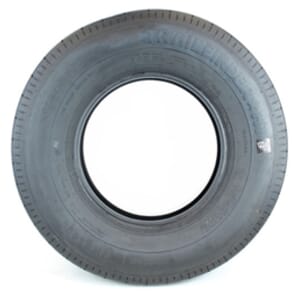
Look at the sidewall of a trailer tire and the size starts with two letters: ST. Look at a pickup tire and you will usually see LT, and a car tire often starts with P. All three can be the same diameter and fit the same size wheel, so it is fair to ask whether it matters which one goes on a trailer. It does, mostly because of how much weight each tire is allowed to carry once it is on a trailer.
This guide explains what ST, LT and P mean on a trailer, why ST tires are the normal choice, how to read an ST tire size and load range, how radial and bias ST tires compare, and how to match the tire to the wheel. It draws on the TrailStar tire and wheel catalog, Dexter's 2,000 to 8,000 lb. axle service manual and our listings. Use it as an overview, and go by the tire and wheel markings and the listing for the exact part.
Key takeaways
- ST tires are made for trailers. TrailStar, which makes the TrailFinder radial and TexStar bias tires we carry, calls them ST trailer tires.
- The sidewall rating is not always the trailer rating. Dexter says to use the load rating molded into the tire for ST and LT tires, but to divide a passenger car tire's rating by 1.10 for trailer use.
- The last letter is the load range. On an ST205/75R15C tire, C is the load range. Higher letters carry more weight at a higher pressure.
- R means radial, D means bias. At the same size and load range, the TrailStar catalog lists the same maximum load for its radial and bias ST tires.
- The wheel has a rating too. A wheel and tire assembly is only good for the lower of the two ratings, and the tire pressure must never go above what the wheel is rated for.
- Check pressure cold. TrailStar says to inflate ST tires to the maximum pressure on the sidewall, checked cold.
Terms used in this guide
- ST tire: A trailer tire. The size on the sidewall starts with ST, for example ST205/75R15.
- LT tire: A light truck tire. The size starts with LT.
- P tire (passenger car tire): A car tire. Dexter calls these passenger car tires.
- Load range: The letter at the end of the size (B, C, D, E and up). It goes with a ply rating and sets how much the tire can carry and at what pressure.
- Ply rating: A strength rating that goes with the load range, such as 6 ply for load range C or 10 ply for load range E.
- Radial and bias: Two ways of building a tire. In an ST size, R means radial and D means bias.
- Max load: The most weight one tire can carry at its maximum cold pressure. It is a per-tire number.
- Cold pressure: Tire pressure checked before the trailer is driven, when the tires are at outside temperature.
ST, LT and P: what the letters mean on a trailer
The letters at the front of the size tell you what kind of vehicle the tire was built for. That matters on a trailer because the load rating on the sidewall was set for that use. Dexter's service manual puts it plainly: the capacity rating molded into the sidewall is not always the proper rating for a tire used on a trailer. Its guidelines:
| Tire type | Size starts with | Load rating to use on a trailer (Dexter) |
|---|---|---|
| Trailer tire | ST | The capacity rating molded into the tire |
| Light truck tire | LT | The capacity rating molded into the tire |
| Passenger car tire | P | The capacity rating molded into the sidewall divided by 1.10 |
Here is what that means for a passenger tire. A passenger tire with 1,820 lbs. molded on the sidewall is good for about 1,654 lbs. on a trailer (1,820 divided by 1.10). An ST205/75R15C trailer tire is listed at 1,820 lbs. in the TrailStar catalog, and on a trailer it keeps its full 1,820 lbs. Two tires that look the same can carry different loads once they are under a trailer.
Dexter adds two checks that apply to any tire on a trailer axle. First, the wheel's rim size and contour must be approved for the tire. Second, the tire must carry the rated load, and if the weight is not even on every tire, pick the tire for the heaviest wheel position.
Why ST tires are the trailer choice
- They are built and rated for trailers. TrailStar makes its TrailFinder radials and TexStar bias tires as ST trailer tires for trailer builders, and the catalog lists each one by trailer load and pressure.
- The sidewall number is the trailer number. With an ST tire you use the molded rating as is. With a passenger tire you have to take about 9 percent off.
- They match what most trailers came with. Replacing ST tires with ST tires of the same size and load range keeps the same load rating and pressure the trailer was set up for.
- They come mounted. ST tires are sold already mounted on trailer wheels in the common bolt patterns, so you get a wheel and tire that go together.
Some trailer owners still use LT tires. Dexter's guidelines treat LT tires like ST tires for load rating: use the capacity rating molded into the tire. The 13 in. through 16 in. trailer tires we carry are ST tires: TrailFinder radials and TexStar bias tires, plus TrailFinder 17.5 in. radials for heavy trailers.
How to read an ST tire size
Take ST205/75R15C, a common 15 in. trailer tire, one piece at a time:
- ST: A trailer tire.
- 205/75: The tire's size. Match these numbers exactly when you replace a tire. The TrailStar catalog also lists each size's overall diameter and section width in inches, which is handy if you are comparing sizes.
- R: Radial construction. A D in the same spot (ST205/75D15C) means a bias tire.
- 15: The wheel diameter in inches. This tire mounts on a 15 in. wheel.
- C: The load range.
The listing names on our site use the size with the slash taken out, for example ST20575R15C for ST205/75R15C.
Load range and ply rating
The load range letter goes with a ply rating. In the TrailStar catalog the pairs are:
| Load range | Ply rating |
|---|---|
| B | 4 |
| C | 6 |
| D | 8 |
| E | 10 |
| F | 12 |
| G | 14 |
| H | 16 |
| J | 18 |
A higher load range carries more at a higher pressure. In 15 in., for example, the TrailStar catalog lists the ST205/75R15 in load range C at 1,820 lbs. and 50 psi, and the ST225/75R15 in load range E at 2,830 lbs. and 80 psi. When you replace a tire, use the same load range or higher, and never go above the wheel's own rating.
Radial vs bias ST tires
Both are ST trailer tires. At the same size and load range, the TrailStar catalog gives them the same maximum load and pressure. Here are the ST sizes we carry, with the catalog ratings:
| Size | Build | Load range (ply) | Max load per tire | Max cold pressure | Overall diameter |
|---|---|---|---|---|---|
| ST175/80R13 | Radial (TrailFinder) | C (6) | 1,360 lbs. | 50 psi | 23.8 in. |
| ST175/80D13 | Bias (TexStar) | C (6) | 1,360 lbs. | 50 psi | 24.41 in. |
| ST205/75R14 | Radial (TrailFinder) | C (6) | 1,760 lbs. | 50 psi | 25.9 in. |
| ST205/75R15 | Radial (TrailFinder) | C (6) | 1,820 lbs. | 50 psi | 26.9 in. |
| ST205/75D15 | Bias (TexStar) | C (6) | 1,820 lbs. | 50 psi | 26.97 in. |
| ST225/75D15 | Bias (TexStar) | D (8) | 2,540 lbs. | 65 psi | 28.70 in. |
| ST225/75R15 | Radial (TrailFinder) | E (10) | 2,830 lbs. | 80 psi | 28.2 in. |
| ST235/80R16 | Radial (TrailFinder) | E (10) | 3,520 lbs. single, 3,080 lbs. dual | 80 psi | 30.6 in. |
| 215/75R17.5 | All-steel radial (TrailFinder TF200) | H (16) | 4,805 lbs. single, 4,540 lbs. dual | 125 psi | 30.2 in. |
| 235/75R17.5 | All-steel radial (TrailFinder TF200) | J (18) | 6,005 lbs. single, 5,675 lbs. dual | 125 psi | 30.2 in. |
A few things stand out. The bias and radial tires in the same size and load range carry the same load. The 15 in. size is where the choice widens: load range C for lighter trailers, D in bias, and E in radial for heavier ones. Our 16 in. tire is a load range E radial. When the catalog lists two load numbers, such as 3,520/3,080, those are the single and dual ratings: 3,520 lbs. as a single tire and 3,080 lbs. when the tire runs as one of a pair of duals. The 17.5 in. TrailFinder TF200 all-steel radials are listed on TrailStar's ST radial page (the size does not start with ST). The 215/75R17.5 in load range H is rated 4,805 lbs. single and 4,540 lbs. dual at 125 psi; the 235/75R17.5 in load range J is rated 6,005 lbs. single and 5,675 lbs. dual at 125 psi. We sell those sizes already mounted on 17.5 in. hub pilot wheels.
If you are replacing only some of the tires on an axle, we suggest matching the size, the build (radial or bias) and the load range of the tires already on it. If you are not sure what you have, read the full size off the sidewall and call us.
Match the tire to the wheel
A tire is only as good as the wheel it is mounted on. Dexter warns that some tires call for a maximum pressure above what the rim or wheel can take, and says never to exceed the wheel's maximum pressure. The load works the same way: a wheel and tire assembly can carry only the lower of the two ratings. Here is how some of our mounted assemblies line up, using the TrailStar catalog ratings for the wheel and tire:
| Assembly | Wheel (bolt pattern) | Wheel max load | Tire | Tire max load |
|---|---|---|---|---|
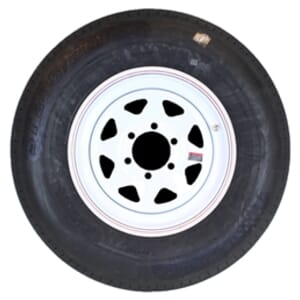
| 13 in. white spoke, radial or bias | 13 x 4.5 (5 on 4-1/2 in.) | 1,660 lbs. | ST175/80R13C or ST175/80D13C | 1,360 lbs. |
| 15 in. silver modular, radial | 15 x 6 (6 on 5-1/2 in.) | 2,850 lbs. | ST225/75R15E | 2,830 lbs. |
| 16 in. white spoke, radial | 16 x 6 (6 on 5-1/2 in.) | 3,200 lbs. | ST235/80R16E | 3,520 lbs. |
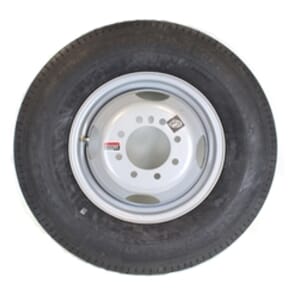
| 16 in. silver modular, radial | 16 x 6 (8 on 6-1/2 in.) | 4,000 lbs. | ST235/80R16E | 3,520 lbs. |
| 16 in. dual wheel, radial | 16 x 6 dual (8 on 6-1/2 in.) | 3,750 lbs. | ST235/80R16E | 3,080 lbs. dual |
| 17.5 in. single, 215/75R17.5 | 17.5 x 6.75 hub pilot (8 on 6-1/2 in.) | 6,005 lbs. | 215/75R17.5, load range H | 4,805 lbs. single |
| 17.5 in. single, 235/75R17.5 | 17.5 x 6.75 hub pilot (8 on 6-1/2 in.) | 6,005 lbs. | 235/75R17.5, load range J | 6,005 lbs. single |
The assembly is only as strong as its weakest part: it can carry only the lower of the wheel and tire ratings, and the weakest link sets the rating. In the 13 in. examples, the 16 in. 8-lug examples and the 17.5 in. 215/75R17.5 assembly, the tire is the limit. On the 16 in. 6 on 5-1/2 in. white spoke assembly, the wheel is the limit: the ST235/80R16E tire is rated 3,520 lbs., but the 16 x 6 wheel is rated 3,200 lbs., so the assembly is good for 3,200 lbs. The 17.5 in. 235/75R17.5 assembly is even: the wheel and the tire are both rated 6,005 lbs. Add up the lower of the wheel and tire ratings on an axle and make sure the total is at least the axle rating. For more on wheel ratings, bolt patterns and hub pilot wheels, see Trailer Wheel Load Ratings and Hub Pilot vs Stud Pilot Wheels. If you are replacing a wheel too, check the offset with our wheel offset guide.
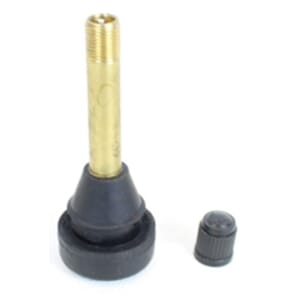
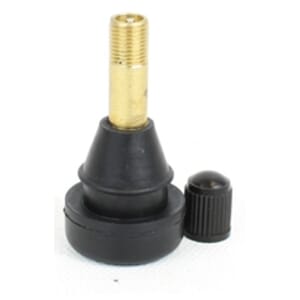
Higher load ranges also mean higher pressure. Load range E tires run at 80 psi, so the valve stem has to be rated for it. We carry a 1.25 in. high pressure valve stem rated to 80 psi and a 2 in. high pressure valve stem.
Common sizes, ready to mount
You can also buy an ST tire already mounted on a trailer wheel. These are some of the wheel and tire assemblies we carry:
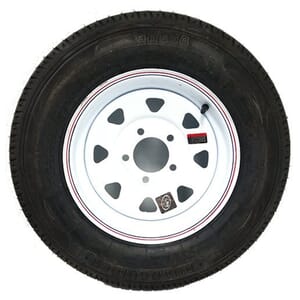
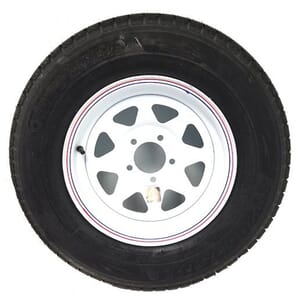
- 13 in.: white spoke with an ST175/80R13C radial or ST175/80D13C bias, 5 on 4-1/2 in. See all 13 in. trailer wheels, tires and assemblies.
- 14 in.: white spoke with an ST205/75R14C radial, 5 on 4-1/2 in. See all 14 in. trailer wheels, tires and assemblies.
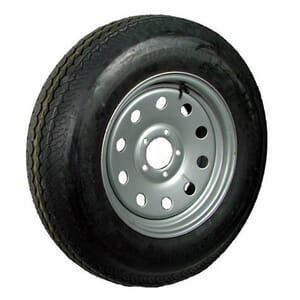
- 15 in.: silver modular with an ST205/75R15C radial, 5 on 4-1/2 in., or silver modular with an ST225/75R15E radial, 6 on 5-1/2 in. See all 15 in. trailer wheels, tires and assemblies.
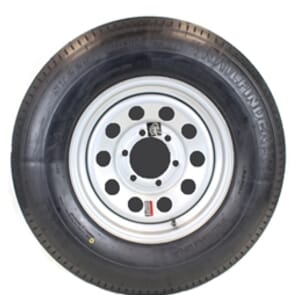
- 16 in.: white spoke with an ST235/80R16E radial, 6 on 5-1/2 in., silver modular, 8 on 6-1/2 in., and a dual wheel for Dexter axles. See all 16 in. trailer wheels, tires and assemblies.
- 17.5 in.: hub pilot single wheels with a TrailFinder 215/75R17.5 16 ply (load range H: 4,805 lbs. single or 4,540 lbs. dual at 125 psi) or 235/75R17.5 18 ply (load range J: 6,005 lbs. single or 5,675 lbs. dual at 125 psi) all-steel radial. TrailStar lists these heavy trailer tires on its ST radial page. See all 17.5 in. trailer wheels, tires and assemblies.
Not sure which axle rating you need the tires to cover? Choosing Trailer Axle Capacity: Hitch Weight, GAWR, Wheels and Tires walks through it.
Inflation, tread and loading
TrailStar and Dexter agree that pressure is the biggest thing you control. Their advice:
- Inflate to the maximum on the sidewall. TrailStar says ST tires should be inflated to their maximum air pressure, which is on the sidewall along with the maximum load.
- Check it cold. Take the reading before the trailer is driven, with the trailer empty and on flat ground. Do not let air out of hot tires.
- Check it often. TrailStar says at least monthly. Dexter says weekly while the trailer is in use.
- Do not overinflate. Tires heat up and expand as you drive. TrailStar warns that an overinflated tire can blow out, and the wheel's maximum pressure is always the upper limit.
- Watch the tread. TrailStar's minimum is 1/16 in. of tread depth, measured with a tread depth gauge.
- Do not overload. Never load the trailer beyond the manufacturer's design limit (GVW). TrailStar suggests about 60 percent of the cargo weight in front and 40 percent in back unless the trailer maker says otherwise.
- Walk around before you go. Check that the load is secure and the wheels are tight and roll freely.
Dexter's tire wear chart ties center wear to overinflation and edge wear to underinflation. Side wear, toe wear, cupping and flat spots point to other problems; see Trailer Axle Alignment and Uneven Tire Wear.
Safety note
Tires and wheels are safety parts. Use tires rated for the load on each wheel, never inflate past the tire's or the wheel's maximum, and support the trailer on rated jack stands, never on the axle or suspension, when you change a wheel. Tighten lug nuts to the wheel maker's torque. If a tire shows cuts, bulges or uneven wear, replace it before you tow a load, or call us before you order.
FAQ
What is the difference between ST and LT tires?
ST tires are trailer tires and LT tires are light truck tires. Some trailer owners still use LT tires. For trailer use, Dexter says to use the load rating molded into the tire for both. The trailer tires we carry are ST tires, made by TrailStar for trailers.
Can I put passenger car tires on a trailer?
Dexter says a passenger car tire's sidewall rating must be divided by 1.10 for trailer use, so it carries less on a trailer than its sidewall says. A tire marked 1,820 lbs. is good for about 1,654 lbs. on a trailer. An ST tire of the same rating keeps its full rating.
What does the C, D or E at the end of a trailer tire size mean?
It is the load range. In the TrailStar catalog, C goes with a 6 ply rating, D with 8 ply and E with 10 ply. A higher load range carries more weight at a higher pressure.
How much air should be in an ST trailer tire?
TrailStar says to inflate ST tires to the maximum pressure on the sidewall, checked cold. For example, the catalog lists 50 psi for load range C, 65 psi for D and 80 psi for E. Never go above the wheel's maximum pressure.
Are radial or bias trailer tires stronger?
At the same size and load range, the TrailStar catalog gives radial and bias ST tires the same maximum load. For example, the ST205/75R15C radial and ST205/75D15C bias are both listed at 1,820 lbs. Pick by the size and load range you need.
Does my wheel limit how much my tire can carry?
Yes. A wheel and tire assembly can carry only the lower of the two ratings; the weakest link sets the rating. For example, an ST235/80R16E tire is rated 3,520 lbs., but on a 16 x 6 wheel rated 3,200 lbs. the assembly is good for 3,200 lbs. Check the wheel's maximum load and pressure as well as the tire's.
When should I replace a trailer tire?
TrailStar's minimum tread depth is 1/16 in. Replace a tire sooner if it is cut, bulged or worn unevenly, and find the cause of uneven wear before you mount new tires.
References
- TrailStar. 2020 tire and wheel catalog: TrailFinder HT radials and TrailQuest radials (ST radial tires, pages 2 and 3), TrailFinder TF200 all steel 17.5 in. radials (page 3), TexStar and All*Star XL bias tires (trailer bias tires, pages 4 and 5), steel and heavy duty steel trailer wheels (pages 6 and 7), and ST Trailer Tires maintenance page (tread depth, pressure and loading).
- Dexter Axle. 2,000 to 8,000 lbs. axle service manual (LIT-001-00, 2018.06): Tires (page 75), Tire Wear Diagnostic Chart (page 76).
- Southwest Wheel product listings for TrailFinder radial and TexStar bias trailer tires, TrailStar wheel and tire assemblies and high pressure valve stems.
Related guides
- Trailer Wheel Load Ratings and Hub Pilot vs Stud Pilot Wheels
- Trailer Wheel Offset: What Dexter Recommends and How to Match a Replacement Wheel
- Choosing Trailer Axle Capacity: Hitch Weight, GAWR, Wheels and Tires
- Trailer Axle Alignment and Uneven Tire Wear: What to Check Before Replacing an Axle
- 3,500 lb. vs 5,200 lb. Trailer Axle: Which One Do You Need
- Trailer Axle Terms: A Plain-English Glossary
Find the right trailer tires
Have the full size off your tire sidewall (including the load range letter), your wheel size and bolt pattern, and your axle rating ready when you shop or call. Southwest Wheel has supplied trailer parts for 107 years, and we can help you match ST tires and wheels to your trailer.
Shop Trailer Wheels, Tires and Assemblies
Know your wheel size? Go straight to 15 in. or 16 in. trailer wheels, tires and assemblies.
Call Southwest Wheel at 1-800-866-3336.
Southwest Wheel - Your Trailers Best Friend Since 1919.


