




Your shopping cart is currently empty.
Trailer Wheel Load Ratings and Hub Pilot vs Stud Pilot Wheels
Two questions decide whether a replacement trailer wheel is safe to bolt on: can it carry the load, and does it mount the same way as the hub it goes on? The first answer is the wheel's load rating. The second is its mounting style: stud piloted, where the lug nuts center the wheel, or hub piloted, where the hub centers the wheel and flange nuts clamp it.
This guide explains what a trailer wheel load rating means, how to add it up against your axle, and how to tell a hub piloted wheel from a stud piloted wheel by its bolt holes, center bore and nuts. It draws on Dexter's wheel bulletins, the TrailStar trailer wheel catalog and the Accuride wheel catalog. Use it as an overview, not a substitute for the instructions supplied with your wheels and axle.
Key takeaways
- A load rating is per wheel. It is the most weight one wheel can carry at its rated cold inflation pressure. Add up every wheel on the axle and compare that total to the axle rating.
- The lowest rated part wins. Dexter says the wheels need enough load capacity and pressure rating to match the maximum load of the axle, the tire and the trailer. A strong wheel does not fix a weak tire, and the reverse is also true.
- Stud piloted wheels center on the studs. The bolt holes are chamfered and cone nuts (60 or 90 degree) seat in them. The center bore is only a clearance hole.
- Hub piloted wheels center on the hub. The center bore fits snugly over a pilot on the hub, the bolt holes are straight through, and flange nuts clamp the wheel.
- Never mix styles or nuts. Match the wheel to the hub's bolt circle, pilot and mounting surface, and use only the nuts made for that wheel.
Terms used in this guide
- Load rating (max load): The most weight one wheel is rated to carry, given in pounds along with a cold inflation pressure in psi.
- Bolt circle (bolt pattern): The number of studs and the diameter of the circle they sit on, such as 5 on 4-1/2 in. or 8 on 6-1/2 in.
- Center bore: The hole in the middle of the wheel. On a hub piloted wheel it is the pilot that centers the wheel. On a stud piloted wheel it only clears the end of the hub.
- Pilot: The machined diameter on a hub that a hub piloted wheel's center bore fits over, such as the 4.75 in. pilot on an 8 on 6-1/2 in. heavy duty hub.
- Cone nut: A lug nut with a tapered (60 or 90 degree) seat that matches a chamfer in the wheel's bolt hole.
- Flange nut: A nut with a flat washer face, either fixed or swiveling, used on hub piloted wheels.
- Single and dual wheels: A single wheel axle has one wheel per side. A dual wheel axle has two wheels per side, mounted back to back.
What a trailer wheel load rating means
Accuride defines wheel capacity as the maximum carrying load, expressed in pounds and inflation pressure (psi) cold. Every trailer wheel has one. It is a per-wheel number, so a wheel rated 1,870 lbs. can carry 1,870 lbs. by itself, not 1,870 lbs. per axle.
Dexter's Bulletin 409 lists capacity as one of the four things to check when you replace a trailer wheel (with bolt circle, offset and rim contour). It says the wheels must have enough load carrying capacity and pressure rating to match the maximum load of the axle, the tire and the trailer. In practice that means three numbers have to line up:
- The axle rating (on the axle tag or the trailer's VIN label).
- The wheel rating, multiplied by the number of wheels on that axle.
- The tire rating, multiplied by the number of tires on that axle, at the inflation the tire maker lists.
The lowest of the three sets the limit. For how axle capacity, hitch weight and GAWR fit together, see Choosing Trailer Axle Capacity: Hitch Weight, GAWR, Wheels and Tires.
How to add up wheel ratings against your axle
Multiply the wheel rating by the number of wheels on one axle. A single wheel axle has two wheels. A dual wheel axle has four. The total has to be at least the axle rating. Here is that math using the maximum loads in TrailStar's trailer wheel catalog:
| TrailStar wheel size and bolt circle | Max load per wheel | Wheels per axle | Total for one axle | Examples we carry |
|---|---|---|---|---|
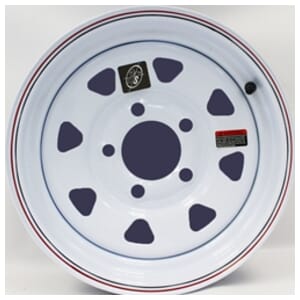
| 13 x 4.5, 5 on 4-1/2 in. | 1,660 lbs. | 2 | 3,320 lbs. | 13 x 4.5 white spoke, 128689 |
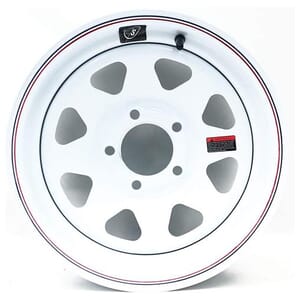
| 14 x 5.5, 5 on 4-1/2 in. | 1,870 lbs. | 2 | 3,740 lbs. | 14 in. white spoke, 128691 |
| 15 x 5, 5 on 4-1/2 in. or 5 on 5 in. | 1,870 lbs. | 2 | 3,740 lbs. | 15 in. white spoke 5 on 4-1/2, 128693, 15 in. silver modular 5 on 4-1/2, 128694GCC, 15 in. white spoke 5 on 5, 129400, 15 in. silver modular 5 on 5, 131616GCC |
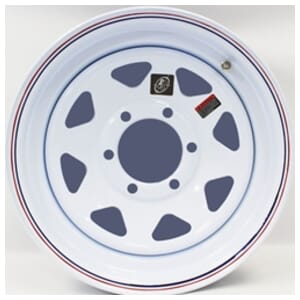
| 15 x 6, 6 on 5-1/2 in. | 2,850 lbs. | 2 | 5,700 lbs. | 15 x 6 white spoke, 128697, 15 x 6 silver modular, 128698GCC |
| 16 x 6, 6 on 5-1/2 in. | 3,200 lbs. | 2 | 6,400 lbs. | 16 x 6 white spoke, 128699, 16 x 6 silver modular, 128700GCC |
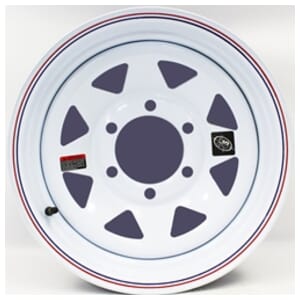
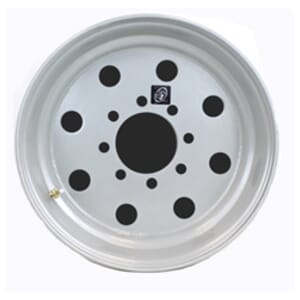
| 16 x 6, 8 on 6-1/2 in. (single) | 4,000 lbs. | 2 | 8,000 lbs. | 16 in. white spoke 8 on 6-1/2, 128701, 16 in. silver modular 8 on 6-1/2, 128702GCC |
| 16 x 6, 8 on 6-1/2 in. (dual) | 3,750 lbs. | 4 | 15,000 lbs. | 16 in. dual, 4.88 in. center bore, 127569 |
| 17.5 x 6.75, 8 on 6-1/2 in. (heavy duty single) | 6,005 lbs. | 2 | 12,010 lbs. | 17.5 x 6.75 single modular hub pilot, 1756758500MOD |
| 17.5 x 6.75, 8 on 275 mm, 8 on 6-1/2 in. or 10 on 8-3/4 in. (heavy duty dual) | 6,200 lbs. | 4 | 24,800 lbs. | 8 on 275 mm dual, 1756758HP4W, 8 on 6-1/2 dual, 175675DW865475, 10 on 8-3/4 dual, 17567510SP2W |
The ratings above are TrailStar's catalog figures for each size and bolt circle. Always confirm the rating on the listing or with the wheel's maker for the exact part number before you buy. For example, a 3,500 lb. axle on two 15 in. 5 lug wheels has 3,740 lbs. of wheel capacity, which clears it. A 5,200 lb. axle on two 15 x 6 in. 6 lug wheels has 5,700 lbs., which also clears it. An 8,000 lb. axle on two 16 in. 8 lug single wheels has exactly 8,000 lbs., which meets the rating with nothing to spare.
Two more points. First, the wheel total only covers the wheels; the tires are a separate check. Second, the same size and bolt circle does not always mean the same rating. TrailStar rates its 16 x 6 in. 8 on 6-1/2 in. single wheel at 4,000 lbs. but its dual wheel of the same size at 3,750 lbs., so go by the exact part number.
Where to find a wheel's rating
- The listing or the maker's catalog. Look up the wheel by its part number. Wheel catalogs list the maximum load and inflation for each part number.
- The wheel itself. Wheel makers stamp identifying marks on the wheel. Accuride, for example, stamps the part number and a date code on its steel and aluminum wheels. Use that part number to look up the rating.
- When in doubt, call. Do not guess a rating from the wheel's diameter or how heavy it feels.
Stud piloted vs hub piloted: what centers the wheel
Every wheel has to be centered on the hub before the nuts clamp it. There are two ways to do that, and a wheel is built for one or the other.
| Feature | Stud piloted (lug centered) | Hub piloted (hub centered) |
|---|---|---|
| What centers the wheel | Cone nuts seating in chamfered bolt holes | The wheel's center bore fitting over the pilot on the hub |
| Bolt holes | Chamfered (tapered) to match the nut seat | Generally straight through, for stud clearance only |
| Center bore | Clearance only, not a snug fit | Sized to the hub pilot, such as 4.75 in. on an 8 on 6-1/2 in. heavy duty hub |
| Nuts | 60 degree or 90 degree cone nuts | Flange nuts (one piece or two piece, fixed or swiveling) |
| Where you see it on trailers | Most 12 in. through 16.5 in. trailer wheels, which Dexter lists with 60 degree cone nuts | Heavy duty 17.5 in. wheels on 8 lug and larger hubs |
Accuride's glossary puts it this way: stud piloted wheels are designed to center on the studs of a hub, with chamfers at the bolt holes into which a ball seat or conical nut is installed, and the center bore is only for clearance of the axle end. Hub piloted wheels are designed to center on the hub at the bore of the wheel, generally have straight through bolt holes, and are used with two piece flange nuts.
How to tell which one you have
- Look at the nuts. A nut with a tapered nose is a cone nut, the sign of a stud piloted wheel. A nut with a flat washer face is a flange nut, the sign of a hub piloted wheel.
- Look at the bolt holes. With the wheel off, a stud piloted wheel's holes are chamfered on the outside face. A hub piloted wheel's holes are straight.
- Check the center bore against the hub. On a hub piloted setup the bore slips snugly over a machined pilot on the hub. On a stud piloted setup there is a gap all the way around.
- Read the hub listing. Heavy duty hubs often name the pilot, such as the Dexter 9,000 to 10,000 lb. hub, 8 on 6.50 in., 4.75 in. pilot (008-288-03).
The same 8,000 lb. Dexter hub and drum is sold with different nut styles, which shows why this matters. Pick the one that matches your wheels:
- Flange nuts, for hub piloted wheels: grease hub and drum, 5/8 in. studs, flange nuts (K08-285-97) or oil hub and drum, flange nuts (K08-285-93).
- 90 degree cone nuts: grease hub and drum, 5/8 in. studs, 90 degree cone nuts (K08-285-96) or oil hub and drum, 90 degree cone nuts (K08-285-90).
- 60 degree cone nuts: oil hub and drum, 9/16 in. studs, 60 degree cone nuts (K08-285-92).
Browse every Dexter and Lippert hub in trailer hubs with parts.
Match the nuts to the wheel
Dexter's Bulletin 409 says to use only fasteners matched to the cone angle of your wheel, usually 60 or 90 degrees. A cone nut on a hub piloted wheel has no chamfer to seat in, and a flange nut on a stud piloted wheel does not center it. Either way the wheel is not clamped the way it was designed to be.
| Wheel and mounting | Nut style | Nuts we carry |
|---|---|---|
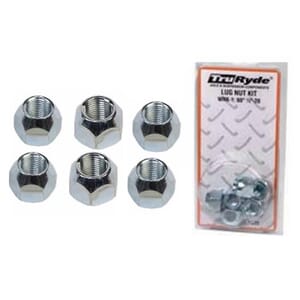
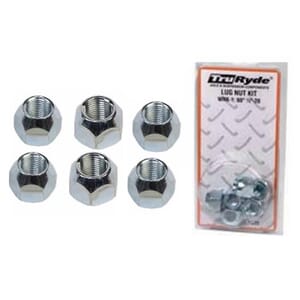
| Stud piloted, 1/2-20 studs (most 12 in. to 16 in. wheels on 5 and 6 lug hubs) | 60 degree cone nut | TruRyde 1/2-20 60 degree wheel nut (FA-6-080), 6 pack (PP-WNK-1), 16 pack (X1023RX16) |
| Stud piloted, 9/16-18 studs (16 in. 8 lug wheels on heavier hubs) | 60 degree cone nut | TruRyde 9/16-18 60 degree cone nut (FA-6-053), 8 pack (PP-WNK-2) |
| 5/8-18 studs, wheels made for 90 degree nuts | 90 degree cone nut | TruRyde 5/8-18 90 degree nut (FA-6-109), 8 pack (PP-WNK-3), Dexter 4 pack (K71-347-00), Dexter 8 pack (006-109-00X8) |
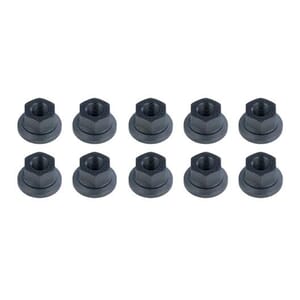
| Hub piloted, 5/8-18 studs | Flange nut (fixed) | Lippert 5/8-18 hex flange lug nut, 10 pack (2025027782) |
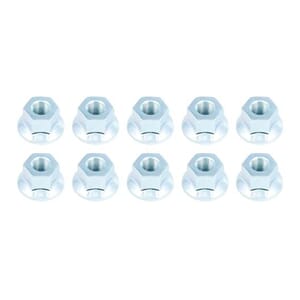
| Hub piloted, 5/8-18 studs | Flange nut (swiveling) | Lippert 5/8-18 swiveling flange lug nut, 10 pack (2025027784), 2 piece swiveling flange nut (39946), 8 pack (39946X8) |
Some heavy duty setups break the simple rule, so go by the wheel maker. Dexter's torque table lists a 16.5 x 9.75 in. wheel as a special stud piloted wheel with 90 degree cone nuts, and a 17.5 in. hub pilot wheel that is held with a clamp ring and 90 degree cone nuts. See all nuts in lug nuts for trailer hubs and drums.
17.5 in. hub piloted trailer wheels
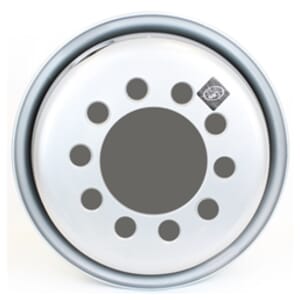
Many heavy duty 17.5 in. trailer wheels are hub piloted. TrailStar notes that its 17.5 x 6.75 in. 8 lug, 6-1/2 in. bolt circle dual wheel requires flange nuts and fits a 4.75 in. hub pilot only. Hub piloted 17.5 in. wheels we carry include:
- TrailStar 17.5 x 6.75 single modular hub pilot trailer wheel (1756758500MOD)
- Alcoa 17.5 x 6.75 hub piloted wheel for 8,000 lb. axles (661401)
- Sunrise 17.5 x 6.75 aluminum hub pilot wheel, 8 on 6-1/2 in., 4.75 in. center bore (WA1675N1)
- 17.5 x 6.75 dual wheel, 8 on 6-1/2 in. (175675DW865475) and 17.5 x 6.75 dual wheel, 8 on 275 mm (1756758HP4W). Swiveling flange nuts are recommended for these dual wheels.
Not every 17.5 in. dual wheel is hub piloted. The 17.5 x 6.75 dual wheel, 10 on 8-3/4 in. (17567510SP2W) is stud piloted, so it uses cone nuts, not flange nuts.
Torque depends on the nut style. Dexter's Bulletin 409 lists these final values for a 17.5 in. hub pilot wheel on an 8 on 6-1/2 in. bolt circle with 5/8-18 studs:
| 17.5 in. hub pilot mounting | 1st stage | 2nd stage | Final torque |
|---|---|---|---|
| Flange nut | 50-60 ft. lbs. | 90-200 ft. lbs. | 275-325 ft. lbs. |
| Swiveling flange nut | 50-60 ft. lbs. | 60-110 ft. lbs. | 150-175 ft. lbs. |
| Clamp ring with 90 degree cone nuts, greased threads | 50-60 ft. lbs. | 100-120 ft. lbs. | 190-210 ft. lbs. |
Dexter also says to consult the wheel manufacturer for the right torque for your wheels, so check the wheel maker's figure first. The full staged tightening procedure, the re-torque schedule and the three-thread rule are in Trailer Wheel Offset: What Dexter Recommends and How to Match a Replacement Wheel.
Use trailer wheels on trailers
Dexter's Bulletin 404 says its product lines are trailer specific and that automotive or non-trailer wheel designs can result in incorrect offset or fitment. Some truck wheels share a trailer bolt circle, and some are even marked by their makers as not for trailer use. A wheel that bolts on is not proof that it fits: the pilot, the nut seat, the offset and the load rating all have to match. Our 15 in. and 16 in. trailer wheels are listed in 15 in. trailer wheels, tires and assemblies and 16 in. trailer wheels, tires and assemblies.
Checklist before you order a replacement wheel
- Bolt circle. Count the studs and confirm the circle. Dexter warns that some bolt circles differ by so little that a wrong wheel can be bolted on.
- Mounting style. Stud piloted or hub piloted, the same as the hub and the old wheel.
- Center bore. For hub piloted wheels, the bore must match the hub pilot. For stud piloted wheels, it must clear the hub.
- Nuts. The same seat (60 degree, 90 degree or flange) and thread as the wheel calls for.
- Load rating. Rating per wheel times the number of wheels on the axle, at least equal to the axle rating, at the listed inflation.
- Offset. The same as the original. Dexter recommends zero offset, within 1/2 in., for single wheels. See our wheel offset guide.
- Tires. Same size and specification as the originals, with a load rating that also covers the axle.
Safety note
Wheels, nuts and tires are safety equipment. Dexter warns that mismatched tires and rims can come apart with explosive force, that a wheel should never be repaired or modified, and that wheel nuts must be tightened and kept at the proper torque to prevent loose wheels, broken studs and wheel separation. Follow the instructions supplied with your wheels and axle, and have the work checked by a qualified trailer technician before towing. Southwest Wheel sells new parts and does not provide installation service.
FAQ
Is a trailer wheel load rating per wheel or per axle?
Per wheel. Multiply it by the number of wheels on the axle (two for single wheels, four for duals) and compare the total to the axle rating.
Can I put a higher rated wheel on my trailer?
Yes, if everything else matches: bolt circle, mounting style, center bore, nuts, offset and tire size. A higher wheel rating does not raise the axle, tire or trailer rating.
What does hub piloted mean?
The wheel is centered by its center bore fitting over a pilot on the hub, and flange nuts clamp it in place. The bolt holes are straight through.
What does stud piloted or lug centric mean?
The wheel is centered by cone nuts seating in chamfered bolt holes. The center bore only clears the hub.
Can I use 60 degree lug nuts on a hub piloted wheel?
No. Dexter says to use only fasteners matched to the wheel. Hub piloted wheels use flange nuts, and the right nut for any wheel comes from the wheel maker.
Are 16 in. 8 lug trailer wheels hub piloted?
No. 16 in. single trailer wheels, including 8 lug wheels, are stud piloted. Dexter's torque table lists 16 in. wheels on an 8 on 6-1/2 in. bolt circle with 9/16-18 studs and 60 degree cone nuts, which is the stud piloted style.
What center bore does a 17.5 in. hub piloted trailer wheel need?
It must match the hub pilot. On 8 on 6-1/2 in. hubs that is commonly 4.75 in., and TrailStar's 17.5 in. 8 on 6-1/2 in. dual wheel fits a 4.75 in. hub pilot only. The 8 on 275 mm wheels use a 221 mm bore.
References
- Dexter Axle. Product Bulletin #409, Wheel Attachment and Torque Requirements (October 14, 2019).
- Dexter Axle. Product Bulletin #404, Wheel Offset Recommendations (March 26, 2019).
- TrailStar. Trailer tire and wheel catalog (2020), trailer wheels, steel and HD steel pages.
- Accuride. Wheel product catalog (2025), Rim/Wheel Glossary.
Related guides
- Trailer Wheel Offset: What Dexter Recommends and How to Match a Replacement Wheel
- Choosing Trailer Axle Capacity: Hitch Weight, GAWR, Wheels and Tires
- Dexter 9K to 16K Axles: What to Match Before Ordering
- Trailer Hub Bearing Adjustment and Grease, Step by Step
- Trailer Axle Alignment and Uneven Tire Wear: What to Check Before Replacing an Axle
- Trailer Axle Terms: A Plain-English Glossary
Find the right trailer wheel
Have your bolt circle, center bore, lug nut style and axle capacity ready when you shop or call. Southwest Wheel has supplied trailer parts for 107 years, and we can help you match a wheel, its nuts and its load rating to your axle.
Need nuts or a hub to match? See lug nuts for trailer hubs and drums or trailer hubs with parts.
Call Southwest Wheel at 1-800-866-3336.
Southwest Wheel - Your Trailers Best Friend Since 1919.
Shop Related Products: Trailer Wheel Load Ratings and Hub Pilot vs Stud Pilot Wheels
Regular Price:
$618.83
Now:
$578.99
Regular Price:
$600.81
Now:
$491.00


